Phuket · Living solo
The Real Cost of Living in Phuket in 2026 — I Budgeted ฿40,000. I Actually Spend ฿50,000.
Not a Numbeo scrape. I itemized my Phuket month line by line and got ฿40,000. Then I checked 17 months of my own records: ฿50,000. Here's the whole ledger, the gap I can't account for, and why that gap is the most useful number on this page.
- What I itemized
- ≈ ฿39–43k
- What I actually spend
- ≈ ฿50k
- 17-month range
- ฿38–74k
- Health insurance
- ฿0 — uninsured
I itemized my Phuket month line by line — ฿25,000 rent in Phuket Town, food, utilities, a weekly treat — and it came to ฿39,000–43,000. Then I checked 17 months of my own spending records: I actually spend about ฿50,000/month (~$1,470), ranging from ฿38,000 to ฿74,000 depending on the month. That ฿7,000–11,000 gap between the budget I could itemize and the money that actually left my account is the most useful number on this page — because every calculator, and very nearly every person planning this move, makes exactly that mistake. I cook a lot, ride a used bike and go uninsured; add insurance or a sea view and you're in a different tier entirely.
You're weighing one real question: can you actually afford Phuket — and what will it cost you? Every cost-of-living site hands you a tidy average. I'll do something more useful and more uncomfortable: I'll show you my own tidy average, and then show you how wrong it was.
I'm Kai Nakamura, in Phuket since 2024 — living on my own, inland in Phuket Town, not backpacking, not a west-coast sea-view life. When I sat down and itemized my month, line by line, I got ฿39,000–43,000. It's a clean, defensible, believable number, and it is the kind of number every article like this one ends at.
Then I added up 17 months of my actual spending records (August 2024 to December 2025). The real figure is about ฿50,000 a month (~$1,470), with individual months running anywhere from ฿38,000 to ฿74,000.
I was wrong about my own cost of living by roughly a quarter — while living it. That gap is the single most useful thing on this page, and it's the part no calculator can give you, because a calculator can only add up categories you already thought of. Here is the whole ledger, both numbers, and what to do about it.
My real month (฿)
The itemized version first — this is the budget I'd have handed you a year ago, and every line is real:
| Item | ฿ / month | Notes |
|---|---|---|
| Rent | 25,000 | Phuket Town · newer condo w/ pool + gym; internet included · west-coast sea-view resort ≈ 1.5–2× (~฿38–50k) by my read |
| Electricity | ~1,044 | Verified — mean of five consecutive PEA bills, ฿902–฿1,243 (Mar–Jul 2026); June's is photographed below · the swing is AC, not the rate · who bills you changes the rate |
| (getting baht here) | — | How I convert money at all — the rate I got and the 10-second booth check |
| Water | ~100 | |
| Internet | 0 (in rent) | Included; roughly ~฿900 value if billed alone (True list price + VAT) · ~500 Mbps up/down |
| Mobile | ~210 | ฿2,500/year · unlimited data · voice/SMS as used |
| Food — Grab delivery | ~3,000 | 3–4×/week · local Thai ~฿100–150/meal · international (Korean, Japanese, Western) ~฿200–400/meal |
| Food — supermarket | ~2,300 | Groceries, water, household sundries included |
| Food — convenience store | ~3,100 | Snacks/ingredients and beer |
| Transport (motorbike fuel) | ~150 | Almost no other transport spend |
| Health insurance | 0 | Uninsured — see below |
| Leisure | ~4,000–8,000 | About 1×/week, ฿1,000–2,000 per outing · unit prices below |
| Itemized total | ≈ 39,000–43,000 | What the lines above add up to |
| What actually leaves my account | ≈ 50,000 | Median of 17 months (Aug 2024 – Dec 2025); range ฿38,000–74,000 |
| The gap | ≈ 7,000–11,000 | Money I spend and cannot put a name to — see below |
The electricity line isn't an estimate — it's the mean of five consecutive bills running ฿902.14 to ฿1,242.64, a spread of about ฿340 between the cheapest month and the dearest. Here's the actual bill one of them came from — a one-bedroom condo with the AC on most nights, inland where it's hotter than the coast:
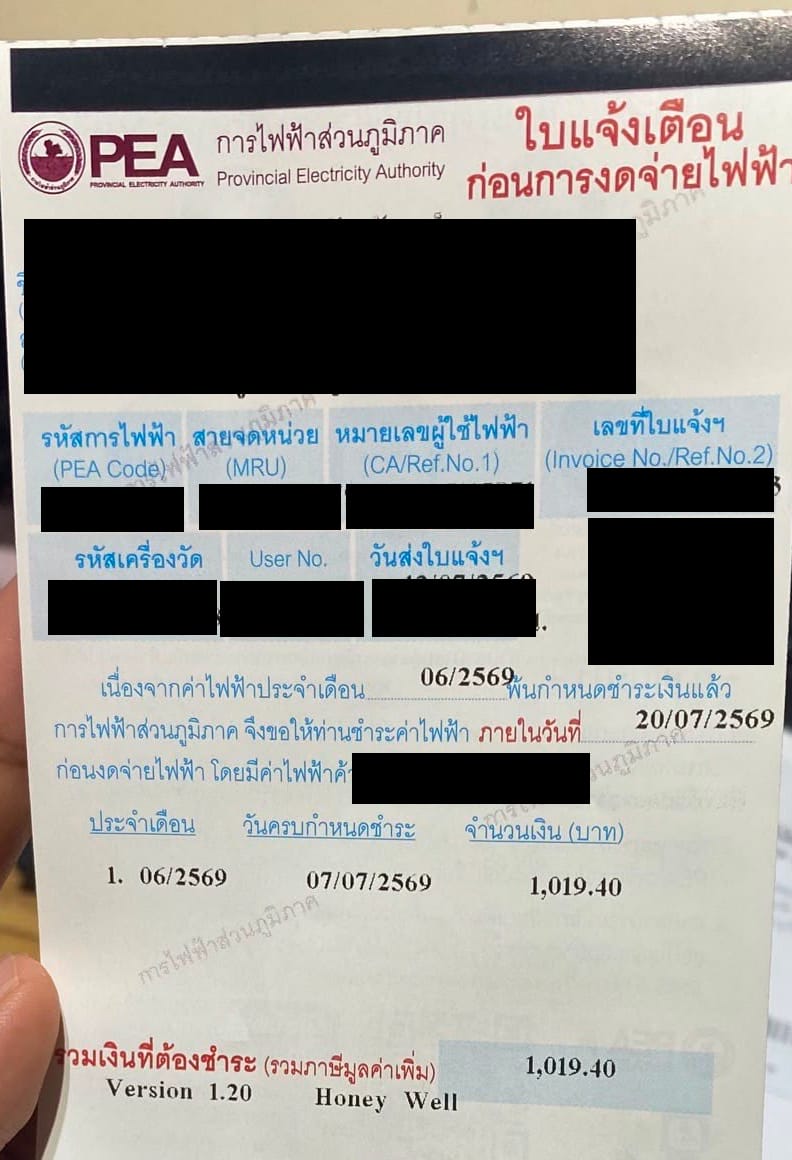
The useful thing about having five of them rather than one: the totals move by a third and the price per unit does not. Every bill in that run divides down to between ฿4.10 and ฿4.18 a unit — so the expensive months are months I bought more electricity, not months electricity cost more. Budget against the top of the range, because the hot months are the ones you will be at home for. What the per-unit number is for, and why it is the only check worth doing on a Thai utility bill, is a page of its own.
Food is the line that catches most people out. Mine is about ฿8,400/month (delivery + supermarket + convenience) — the second-biggest cost after rent, and the one aggregators most underplay. Here's the useful part for your budget: it isn't restaurants that do it. I cook cheap staples and rarely eat out — what pushes the number up is Grab delivery a few times a week and convenience-store beer. Watch those two habits in your own week and you'll predict your food line better than any average will. Here's one of those runs:
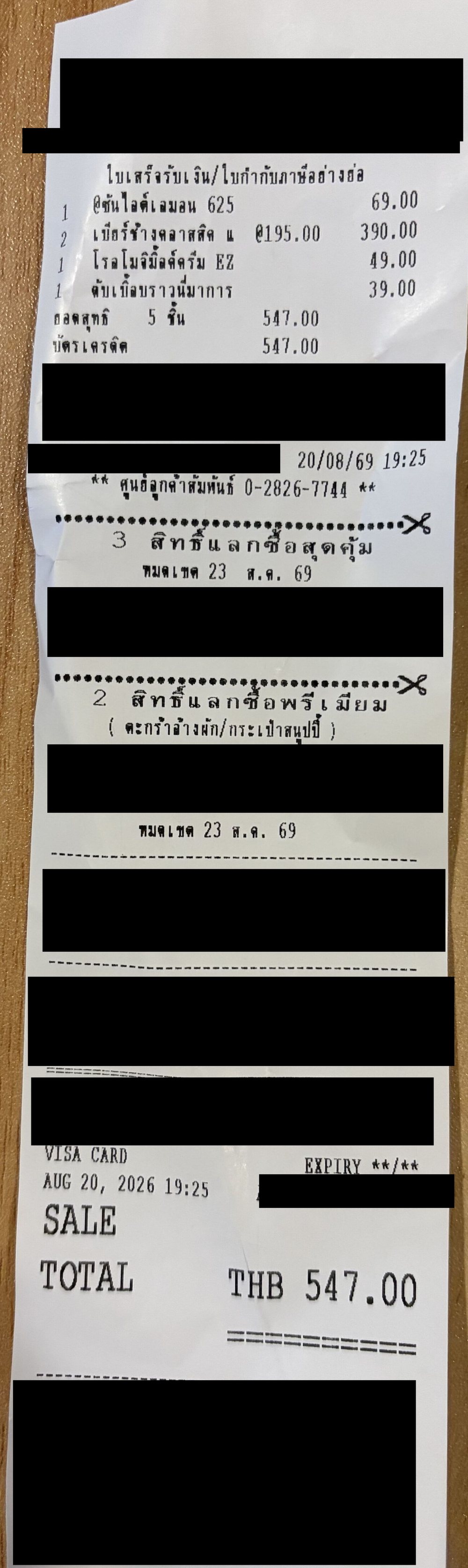
That's a single evening's stop: ฿547, and ฿390 of it — 71% — is beer. Nothing about it feels like spending money at the time, which is exactly the problem. Do that a few times a week and you've found most of my ฿8,400 food line without eating in a single restaurant.
There is a second thing in that food line, and the two figures in the table above don't say it out loud. Thai food here is not cheap so much as it is an outlier, and everything else costs roughly what you would expect.
I eat at the same canteen most weeks. On 6 September 2026 lunch there was gaprao with pork, ฿80, with a fried egg on top for ฿10. Three days later, 9 September, I ordered the sundubu jjigae off the same counter: ฿200, four banchan included.
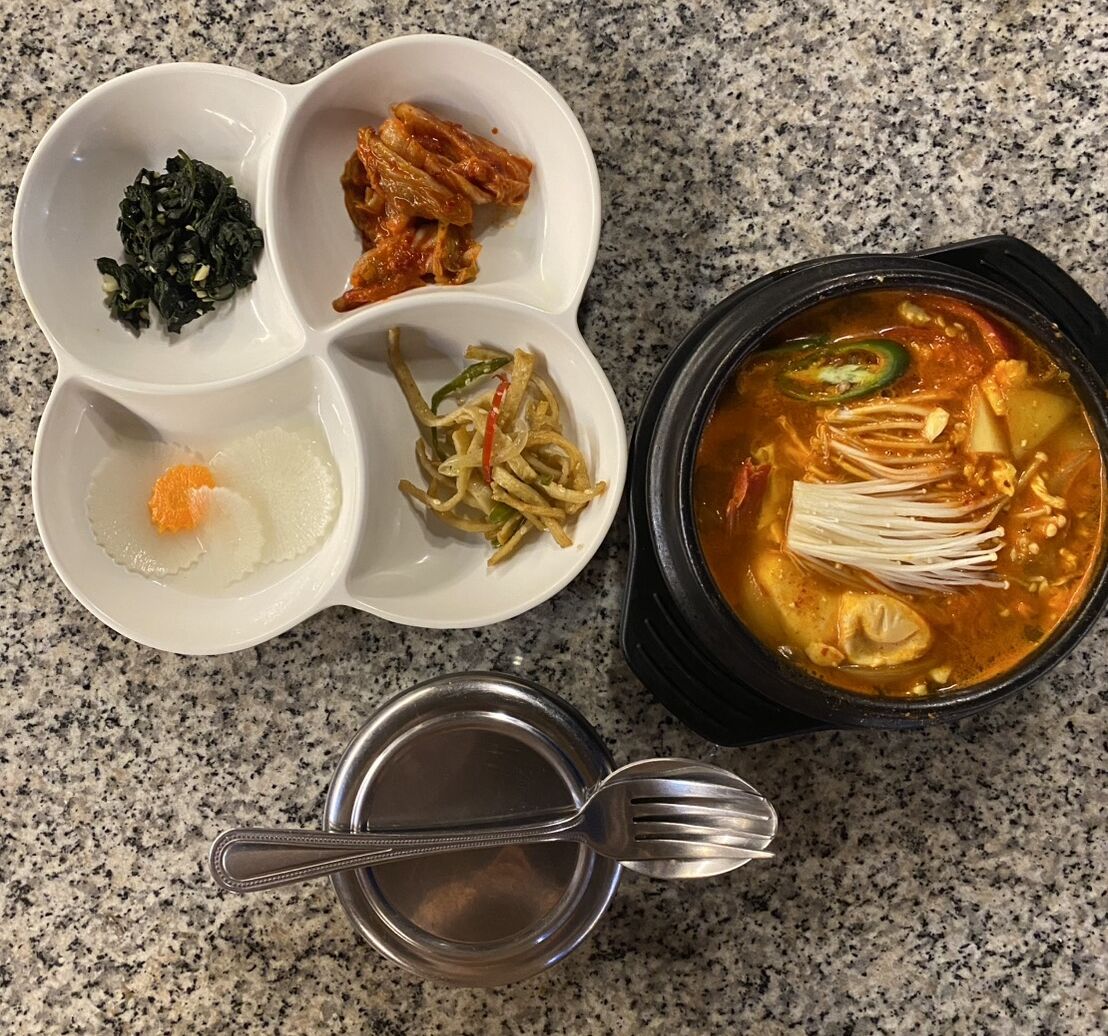
Same room, same till, two and a half times the price — and of the two, ฿200 is the one behaving normally. Food here that isn't Thai costs about what I would pay for it anywhere. The ฿80 plate is the line on the price list that doesn't.
Which moves the lever on your food budget somewhere unexpected. It is not how often you eat out. It is how often what you eat is Thai. Eat Thai six days out of seven and you land near my ฿8,400; reverse that ratio and you are on a different page of this budget without having eaten one extra meal.
The ฿10,000 gap
Rent is ฿25,000. Everything I can itemize on top of it comes to about ฿15,000. But my non-rent spending is actually closer to ฿25,000 — as much again as the rent.
I want to be straight with you: I can't fully itemize the difference. I know it's real, because it's the money that left the account. I know roughly where it goes, but not with the precision of the lines above, so I'm not going to invent a table for it. Honestly, the most likely pieces:
- Weeks that aren't the average week. "Once a week, ฿1–2k" is true as a habit. Some months have three good weekends in them.
- Things that only happen once. A repair, a doctor's visit, a new pair of shoes, replacing something that broke, a bit of admin. Individually forgettable; collectively, thousands of baht a month.
- Cash. Money that comes out of the account and gets spent without ever landing in a category.
None of that is exotic. That's exactly why it's dangerous: it's the part of your spending that has no name, so it never makes it into your plan. Aggregators can't model it — they only sum categories. And you can't model it either, until you've lived somewhere long enough to have records to look back at.
So here is the practical instruction, and it's the thing I'd most want someone to take from this page:
Itemize your Phuket budget as honestly as you can — then add 25% and treat that as your number.
If your itemized plan is ฿40,000, plan on ฿50,000. If your ceiling really is ฿40,000, then go cheaper on rent than my ฿25,000, so the gap has somewhere to live.
Three solo tiers, built from my ledger
Averages hide the only decision that matters: what kind of month are you actually buying? So here are three tiers for one person. The middle row is my measured spend, not my itemized guess. The outer two are estimates built from the same base — I show how, so you can argue with the arithmetic instead of trusting me.
| Tier | ฿ / month | ≈ USD | What it buys — and how it's built |
|---|---|---|---|
| Survival (estimate) | 25,000–30,000 | ~$735–880 | Cheaper inland rent (฿15–18k, Rawai/Chalong tier), cook nearly every meal, utilities + mobile + fuel (~฿1.5k), internet billed separately, almost no leisure, uninsured — and a small allowance for the unnamed spend above, because it doesn't go to zero just because you're frugal. You're present on the island. |
| Mine (measured, 17 months) | 46,000–55,000 | ~$1,350–1,620 | ฿25,000 Phuket Town condo (pool + gym, internet in rent), eat what I want including delivery, a treat most weeks, and about ฿10,000 of spending I can't put a name to. Uninsured. Typical month ฿50,000; the full range was ฿38,000–74,000. |
| Nothing denied (estimate) | 70,000–85,000 | ~$2,060–2,500 | West-coast sea-view rent (฿38–50k), my real non-rent spending (~฿25k, gap included), health insurance (~฿6k), and more eating out. Same island, better view, actual safety net. |
The honest shape of this is not "cheap island, pick a tier." It's that each step up costs roughly ฿20,000–25,000, and what you get for the second step is mostly a sea view and a safety net — not more free time, and not a better Tuesday. Which brings us to the part that surprised me most about living here.
One line I have deliberately not priced into any tier: travel off the island. Trips away are a real part of a good year here, and so is going back to wherever you came from — but they're lumpy, not monthly, so folding them into a monthly figure would flatter the number. Budget them separately; there's more on this further down.
What freedom actually costs (and the ฿0 lines)
Here's the thing that took me a while to notice living here: the parts of a solo day that actually feel good are the cheapest things on the island. (What an ordinary solo week here actually contains, and what goes wrong in one, is here.) These are my real unit prices, checked July 2026:
| A free-feeling thing | ฿ | The catch |
|---|---|---|
| The sea, a swim, the sunset | 0 | The most "resort" part of the day is free. Public beaches, every evening. |
| Deciding your own hours | 0 | Nobody to negotiate the day with. The core of it — and it's included at every tier. |
| Sauna | ~170 | On a 10-pass (฿1,700); ~฿200 walk-in. |
| Thai massage, 90 min | ~500 | Everywhere, no booking. |
| Sea-view dinner + a drink or two | 800–1,000 | The one that feels like a holiday; still under ฿1k. |
| Haircut | ~500 | — |
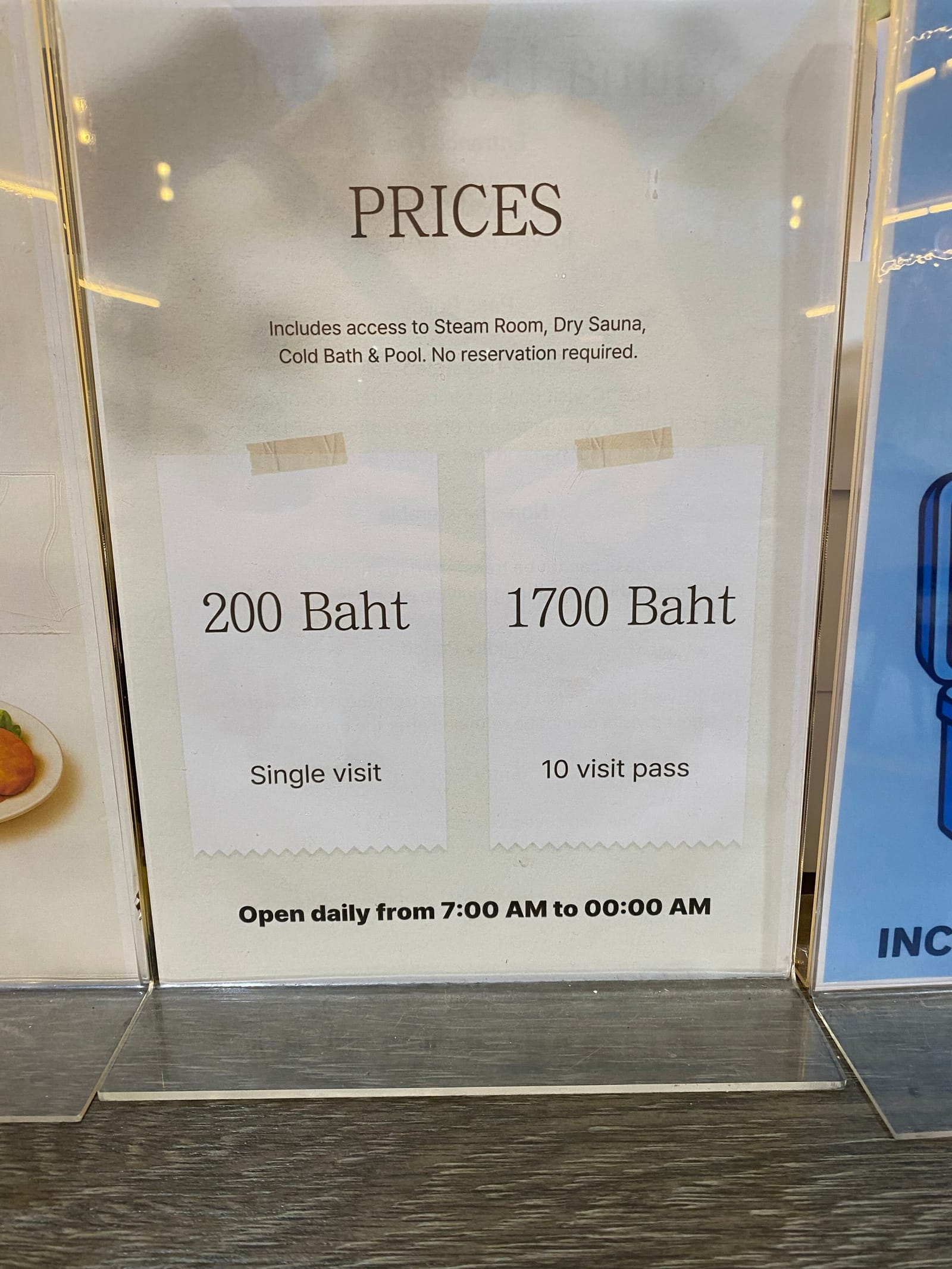
Put a sauna, a massage and a sea-view dinner in the same week and you've spent under ฿1,700 on the parts that make the week feel good. That's worth holding onto while you read the rest of this page: the enjoyable part of living here is not what makes it expensive.
Where money stops buying a better day
Spend past my tier and you're buying real things — just not better days. Being honest about which is which is how you avoid over-saving for a move you could make sooner:
- The sea view (rent 1.5–2×). My inland Phuket Town condo is ฿25,000; the same standard with a west-coast sea view runs roughly ฿38,000–50,000 for rent alone. Beautiful, and a genuinely different daily experience. But the sunset itself looks the same from the public beach for ฿0.
- Insurance (a safety net, not a better Tuesday). I ride uninsured — it's part of why my number is what it is, and it's a real gamble one big hospital bill would win. Cover buys security, which you may well want. Budget it as its own line.
- Imported comfort (Western dining, a car). Familiar food and four wheels buy ease. On an island built for scooters and cheap local meals, they mostly buy the life you had back home, transplanted — which is the opposite of why most people come.
None of these are wrong to buy. The point is to stop believing you need them first.
Rent by area — the biggest swing
(The full grid — every area, by specification, with what my own ฿25,000 actually bought — is in where to live in Phuket.)
Rent is the single line that moves your Phuket number most, and it swings hard by area. Mine (฿25,000, Phuket Town, inland) is the verified one; the rest are the ranges I watch friends pay and see in listings (researched, checked July 2026) for a similar newer 1-bed condo:
| Area | ~ 1-bed / month | The trade-off |
|---|---|---|
| Phuket Town (mine) | ฿20–28k | Inland, local, real-city feel — no beach premium |
| Rawai · Chalong | ฿15–25k | Quiet, south, best value; you'll want a bike |
| Kata · Karon | ฿20–35k | Beach life, mid-range |
| Patong | ฿18–40k | Nightlife + tourist prices; wide range |
| Kamala · Bang Tao · west-coast sea-view | ฿35–55k+ | The resort strip — the view is the premium |
The pattern is simple: go inland and you keep the money; pay for a sea view and rent alone can double. That one choice moves your whole monthly number more than anything else on this page — and it's also the lever that decides whether your unnamed 25% has room to exist. If you're still deciding, start with where to base yourself in Phuket.
And Phuket isn't Thailand's cheapest, either — it's an island, so rent and imported food sit higher than the mainland. Roughly, for a comfortable single (researched 2026): Chiang Mai ฿40–60k · Bangkok ฿60–80k · Phuket ฿70–100k at the beachy end. If rock-bottom cost is the only goal, Chiang Mai wins. Phuket is what you pay for the sea air and the slower pace — I think it's worth it, but it's a real premium, not a bargain.
What the calculators skip
1. The spending with no category
Covered above, and it's the big one: ฿7,000–11,000 a month, about a quarter of my total, that exists in my bank records and in no budget line. If you take one number from this page, take the correction factor, not my total.
2. Food is larger than the spreadsheets imply
If you model "Phuket food" as street meals only, you'll undershoot. My mix — Grab 3–4×/week, supermarket runs that include sundries, and convenience-store beer — adds up to roughly ฿8,400. That's the quiet second rent.
3. Health insurance: ฿0, on purpose (and it's a gamble)
I carry no health insurance. That is why this budget looks achievable. It is also the most important honesty check in this article: I am betting that I won't need expensive care. A single serious hospital stay at a private hospital here can erase years of "savings." Aggregators that show a low monthly total without spelling out coverage are incomplete.
If you do want cover — I don't carry it, so treat this as researched signposting, not a personal recommendation, and get a live quote for your age. Expats and nomads here weigh three routes (rough 2026 monthly):
- Nomad plans (e.g. SafetyWing) — ~$45–160; younger, healthy, on tourist or DTV visas
- Local Thai insurers (Aetna / AIA / Bupa Thailand) — ~$100–200; local hospital networks
- Global expat plans (e.g. Cigna Global) — ~$200–900; older applicants, chronic conditions, families
Premiums climb steeply with age — so budget your own line on top of everything here. My number simply doesn't include it. For the full picture — hospital costs, the four cover routes, and why I still ride uninsured — see my health insurance guide for Phuket.
4. Move-in shock: three months' rent, liquid, on day one
Starting a lease took ฿75,000 out of my account before I unpacked a suitcase — three months of my ฿25,000 rent, but not three months of deposit. Reading my lease again: it was a ฿50,000 security deposit (two months, refundable within 30 days of the lease ending, and the contract says explicitly it can't be used as advance rent) plus the ฿25,000 first month. So two-thirds of that money is mine and comes back — and none of that helps on the day, because all ฿75,000 has to be liquid at once.
That split is worth knowing before you go looking. Two months' deposit plus one month up front is the ordinary shape here, so if someone asks you for more, it isn't the market — it's that deal. Calculators talk about "rent per month"; they rarely force you to feel three months of it leaving at once. Budget a setup war chest, not only a monthly number. The rest of that transaction — how I found the place, what the lease put on me, and why I paid the agent nothing — is in renting a condo in Phuket.
5. Furnished condo = ฿0 furniture
The flip side: my condo came furnished, so furniture spend was ฿0. Compared with what many Western movers expect (sofa, bed, kitchen kit), that is a real saving. If you insist on an unfurnished shell and your own taste, this line becomes a cost again.
6. The home country you haven't fully left
Every cost-of-living page for Phuket — mine included — prices only the Phuket side. What it can't see is that most people who move here don't cleanly stop paying for the place they came from. I still carry some upkeep back home, and I fly back roughly every eight months. Neither is a Phuket cost, which is exactly why no Phuket calculator has a row for either.
They're real, they recur, and they're a common reason a budget that works perfectly on paper still comes up short in the second year. Whatever your home country is, add its upkeep and a flight home as their own lines. Budget for a home country you haven't fully left.
Setup costs (not monthly)
| One-time item | ฿ | Notes |
|---|---|---|
| Move-in cash | 75,000 | ฿50,000 deposit (refundable) + ฿25,000 first month |
| Used motorbike | 20,000 | 10 years old, bought secondhand |
| Furniture | 0 | Condo came furnished |
That's roughly ฿95,000 liquid before month one begins, and it — not the monthly burn — is what actually stops people. The bike matters more than its line suggests: without your own wheels you wait on Grab and stay boxed into one area. ฿20,000 secondhand is the cheapest mobility on this page — see renting vs buying a scooter in Phuket before you decide.
Treat setup as its own bucket. Mixing it into "monthly cost of living" makes the month look worse than it is — and hides the deposit shock that actually matters for decision-making.
Turn my number into yours
My ฿50,000 isn't a target to copy — it's a worked example, and the ฿10,000 I can't itemize is the part I'd most want you to copy. To pressure-test your own number:
- Itemize honestly, then add 25%. Everyone's list is missing the same thing: the spending that has no category. Mine was missing about a quarter, and I live here.
- Rent tier is the whole swing. Inland like me (~฿25k) or a west-coast sea view (1.5–2×)? That single choice moves your tier more than everything else combined — and decides whether your unnamed 25% has room to exist.
- Food habits. How often will you order Grab and grab a beer? That's your quiet second rent.
- Insurance and the home country. I don't carry cover, and I still pay for a life back home. Both are your own lines to add.
- The buffer. You need about ฿95,000 liquid to land, before month one even starts.
I'm not telling you to copy my risk profile, or my number. I'm telling you that the number you're currently planning against is probably too low — because mine was, and I had the advantage of actually being here.
And if Thailand rather than Phuket specifically is what you're weighing, I lived in Bangkok for three years before this — what the move actually cost me puts these numbers against that city's, with both sides from my own rent.
01Who this ~$1,470 life actually suits
Someone fine with ~฿25k in Phuket Town for a newer condo (pool + gym) who cooks cheap meals, rides a used bike, is honest about medical risk — and budgets ฿50,000, not ฿40,000. The itemized lines land near ฿40k; the money that actually leaves lands near ฿50k. Plan against the second number and this life is comfortable, unhurried and genuinely cheaper than most Western cities. I've lived it since 2024, and the parts that make a week here feel good are already inside it.
Anyone set on a sea-view west-coast resort condo, proper health insurance, or frequent Western dining — and anyone budgeting straight off an itemized list. The view alone is roughly 1.5–2× my rent (~฿38–50k before anything else). Add cover and more eating out and you're at ฿70,000–85,000, a different tier entirely. And the quiet one: a spreadsheet that only contains lines you can name will understate your real spend. Mine did, by about a quarter.
02Land online without the airport SIM circus
My local phone line runs about ฿210/month (฿2,500/year, data unlimited, calls/SMS only as billed) — the [full breakdown of what phone and internet cost here](/guides/phone-and-internet-in-phuket) is its own page, including why my home fibre costs me nothing. For a first landing or a trial month, an eSIM is often simpler than hunting a shop on day one — then switch to a local plan if you stay. Honest note: I run a local line now, so treat the eSIM as the easy first-week move, not a lifelong one.
03Uninsured — and honestly weighing it up
Full honesty: I ride uninsured, and it does nag at me — one serious hospital bill here would dwarf years of premiums. SafetyWing is the option I'd look at first when I think about sorting it: Nomad Essential (travel-medical) about $56–63 / 4 weeks for ages 18–39, or Complete for fuller health cover around $177.50 / month. If you're visiting or newly here — short trip, no local safety net yet — it's an easier call than it is for me. Get a live quote for your age.
Frequently asked questions
- How much does it cost to live in Phuket per month?
- About ฿50,000 (~$1,470) for me — a single resident in Phuket Town, checked across 17 months of my own spending records rather than one tidy month. Individual months ran from ฿38,000 to ฿74,000. When I itemized the same life line by line I got ฿39,000–43,000, so treat any itemized Phuket budget, including mine, as roughly 20–25% optimistic.
- Is ฿40,000 a month enough to live in Phuket?
- It's enough to cover everything I can name — ฿25,000 rent, food, utilities, transport and a weekly treat. It was not enough to cover what I actually spend, which is closer to ฿50,000. If ฿40,000 is your ceiling rather than your plan, go cheaper on rent than my ฿25,000 to leave yourself the gap.
- How much is rent in Phuket?
- I pay ฿25,000 for a newer Phuket Town condo with a pool and gym, internet included. The same place with a sea view on the west-coast resort strip runs roughly 1.5–2× (about ฿38,000–50,000). Budget three months of rent as move-in cash — mine was ฿75,000: a ฿50,000 refundable deposit plus the first month up front.
- What is the biggest hidden cost of living in Phuket?
- The gap between the budget you can itemize and the money that actually leaves your account. Mine is ฿7,000–11,000 a month — bigger than my entire food bill's delivery share, and it appears on no calculator because it has no category. After that: food (~฿8,400/month, the quiet second rent), the ฿75,000 of move-in cash (฿50,000 of it a refundable deposit), and health insurance if you carry it.
- How much money do you need saved before moving to Phuket alone?
- Budget a setup war chest separate from the monthly number. Mine was ฿75,000 of move-in cash — a ฿50,000 refundable deposit plus the ฿25,000 first month — plus a ฿20,000 used motorbike, so roughly ฿95,000 before month one even starts. My condo came furnished, so furniture was ฿0; an unfurnished place adds that back. This one-time barrier, not the monthly cost, is what actually stops people.
- Why do cost-of-living calculators underestimate Phuket?
- Because they can only add up categories, and real spending includes things that never get a category — a repair, a doctor's visit, a replacement, a month where you go out more than usual. I proved it on myself: my own itemized ledger came to ฿39,000–43,000 and my actual 17-month median is ฿50,000. The safest correction is to itemize honestly, then add about 25%.
- Do you need health insurance in Phuket?
- You are not forced to, and I do not carry it — which is part of why my number is low. It is a real gamble: one serious hospital stay can erase years of savings. If you want cover, budget for it on top — roughly $45–160/mo for nomad plans, ~$100–200 for local Thai insurers, more for comprehensive global plans (researched 2026; get a real quote for your age).