Phuket · Living solo
Is Living Alone in Phuket Lonely? What Every Guide Gets Wrong About the Question
Ask the internet and you get reassurance: there are a hundred thousand-odd foreigners here, you will find people. That answers how do I avoid being alone. It is not the question most people are asking.
- Living here alone since
- 2024
- What guides answer
- How to avoid it
- An empty afternoon
- ≈ ฿200
- The real hard part
- Admin, not evenings
Probably not — though the reason is not the one every other page gives. I have lived here on my own since 2024. The checkable part:
- Solitary time is cheap and close. A sauna visit is ฿170 on a ten-visit pass, a plate of gaprao ฿80–100 depending where, and the sea is twenty minutes away on a ฿20,000 used scooter. An unplanned afternoon needs no budget.
- Being alone reads as completely ordinary here. Nobody registers someone eating by themselves, and simple English covers a normal week.
- What actually bites is administrative, not emotional — the Thursday afternoon a ceiling light dies and there is nobody in the flat but you. The serious version of the same fact is medical.
- Everything that goes wrong happens in Thai. Simple English is enough for the ordinary day and not enough for the bad one, so arrange translation help before you need it.
- It will not fix loneliness you brought with you. This is a good place to live alone if you are already at ease doing it. It is a poor place to learn how.
Probably not — though the reason is not the one every other page gives. Being alone here is cheap, close and completely unremarkable: nobody thinks twice about someone eating on their own, and an unplanned afternoon costs about ฿200. What actually bites is not the evenings. It is the Thursday afternoon a ceiling light dies and there is nobody in the flat but you to deal with it.
That is the answer. The rest of this page is how I know it, and what it costs.
Search the question and every other page answers a different one: there are around a hundred thousand foreigners on this island, join the community, stay somewhere sociable. That is how to avoid being alone — useful if you are lonely and want that fixed. But plenty of people asking are not looking to have solitude cured. They have arranged their life this way already, and what they want to know is whether the arrangement survives the move.
I have lived here on my own since 2024. I am not going to tell you how it feels, because that is the part that will not transfer. What I can give you is the checkable part: what actually goes wrong, what an ordinary week costs, and where the standard advice is answering the wrong thing.
What are you actually asking?
The question usually hides three different ones, and they have different answers.
"Will my evenings be empty?" Often, yes. Whether that reads to you as bleak or as quiet is the most useful signal in this whole article, and it is not something an article can settle for you.
"Will I be able to meet people if I want to?" Yes, easily. There is a large foreign population, there are gyms and bars and groups and long-stay neighbourhoods full of people in the same position. This is genuinely not hard here, and it is what every other guide is about.
"Will something go wrong that nobody is there for?" This is the real question, and the one the reassuring articles skip. It has a straight answer, and it is the next section.
The part that is genuinely hard
Here it is plainly, because it is the thing the reassuring articles leave out.
You are the only one who can act on your own behalf.
The ordinary version: a ceiling light
This is rarely about feelings. A ceiling light died in my flat on a Thursday. There was nobody else in the place who might deal with it, and nobody to ask whether it was even my responsibility. I read the lease, found that it was, and fixed it myself for ฿268.
That is the shape these moments take: logistics, not sadness. Each one is small. Together they add up to a fact worth understanding before you come — nothing gets done unless you do it.
The serious version: a hospital
I go without health insurance, which is a calculated bet I am open about. The part of that bet specific to living alone is that if something goes badly wrong, there is nobody here whose job it is to handle it: no one to argue at the admissions desk, no one to decide for you if you are not in a state to decide. Living on your own means money is the only thing that can act for you when you cannot. That is the strongest argument against the way I have arranged things, and it is not a mood — it is arithmetic.
The small version: nobody is expecting you home
Nobody is expecting you home. On a long ride I tell someone which way I am going, and anyone living alone here should do something similar. It costs nothing, and it is the cheapest insurance available against a fact that does not go away.
What an ordinary week actually contains
The practical answer is that doing nothing in particular is cheap and close.
| What | What I pay | |
|---|---|---|
| Sauna, one visit | ฿170 | On a ฿1,700 ten-visit pass; ฿200 walk-in |
| Thai massage, ninety minutes | ฿500 | The ordinary local rate, cash |
| A plate of gaprao | ฿80–100 | ฿80 at the place by the sauna, ~฿100 in town |
| Used scooter, bought outright | ฿20,000 | Puts the sea about twenty minutes away |
Beyond that I cook most of the time, order delivery a few times a week, and buy beer at the convenience store like everyone else.
None of that is remarkable, which is the point. An ordinary week here has no occasions in it — days at home, the sea, a sauna, food, a beer, much the same as anywhere, except the friction is low and the weather does not cancel anything.
Here is one of those weeks made concrete, because a specific Sunday is more use than a description of a typical one. Sunday 30 August 2026: the sauna, then into Phuket Town, then out to the sea for the end of the day.
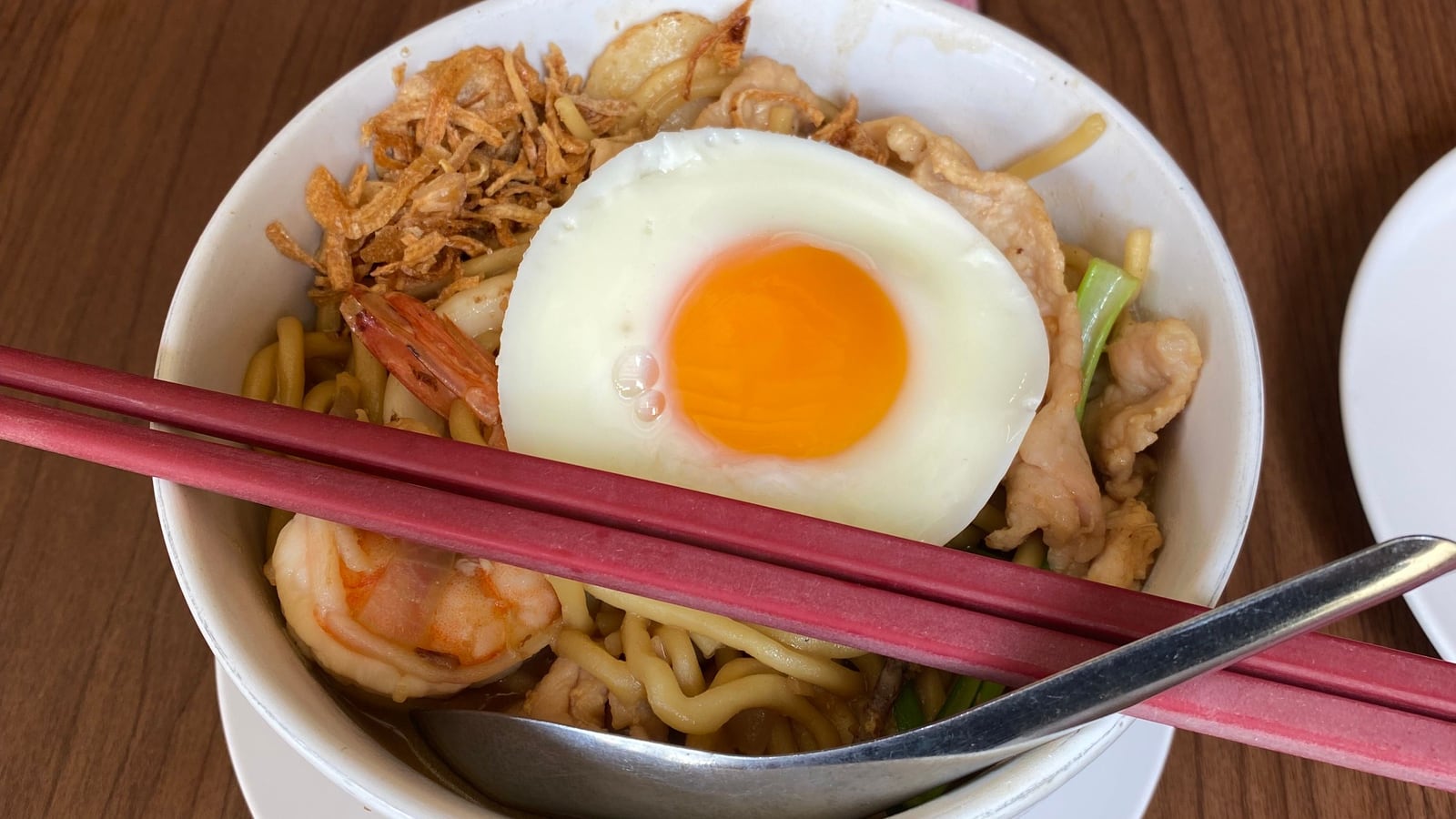
The sauna was ฿170, because I buy the ten-visit pass at ฿1,700 rather than paying ฿200 a time. Lunch in town was a plate of gaprao, about ฿100. Those two numbers are the whole shape of an afternoon here: the things you do on an ordinary day are priced so that doing them is not a decision. At home the equivalent afternoon starts at a number you notice.
The sunset is worth showing properly, because it corrects something this page would otherwise let you assume.
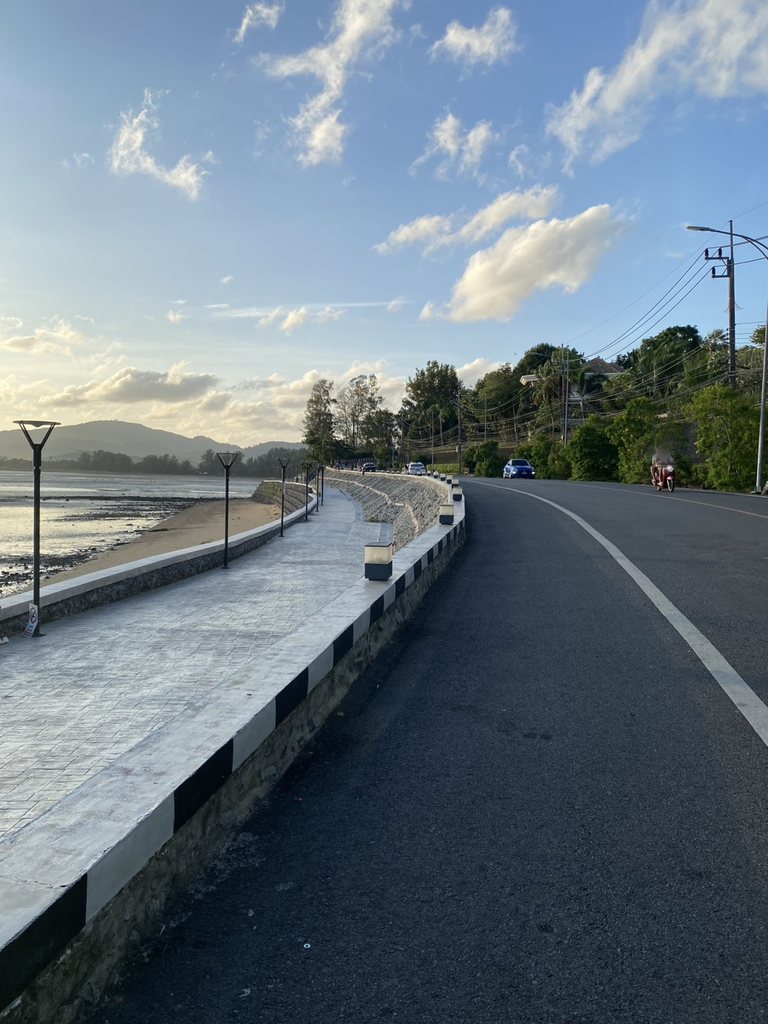
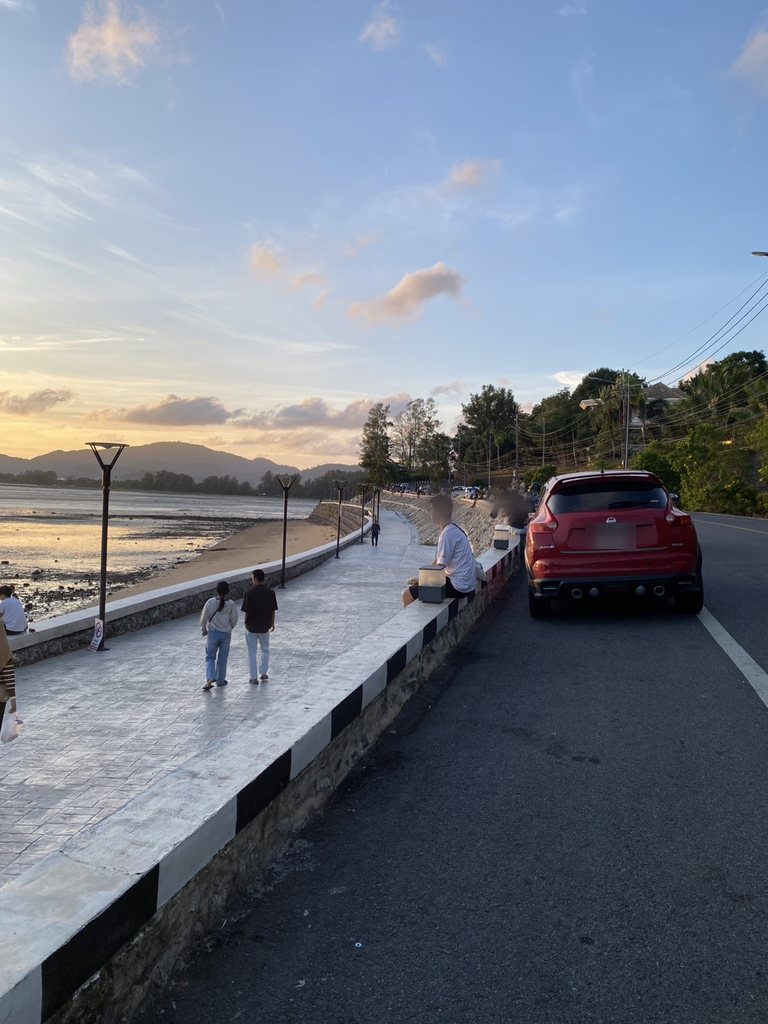
I got there just after five and had it more or less to myself. By the time the sun was actually going down — roughly six to half past — there were about a hundred people: cars nose to tail along the road, the sea wall occupied most of the way down. Same Sunday, same spot, an hour apart.
So the empty-paradise version of this is not true, at least not here and not on a Sunday. You do not get the sunset and the empty promenade — you pick one. Worth knowing before you assemble a picture of your evenings here out of other people's photographs, which are all taken at six and framed to leave the parked cars out.
The hour itself is the part relevant to this page. I sat among a hundred people I did not know and will not see again, on my own, and not one of them registered it — not the couples, not the families, not the man on the wall two metres away. That is the actual texture of solitary time here, and it is neither lonely nor sociable. It is unremarkable, and the unremarkableness is the whole of it: nobody is keeping score of how you spend a Sunday.
The structural fact worth extracting: at home, an unplanned day usually costs money or means staying in. Here it costs a bike and twenty minutes. If you are trying to work out whether solitary time is sustainable somewhere, the price of an empty afternoon tells you more than any amount of advice about joining groups.
One more measurable detail, which I include because it is odd rather than flattering. My Thailand Privilege membership gives me about 35 points a year and roughly 15 go unused, every year — free massages and a concierge sitting there, not got round to. Make of it what you like; it is a real number about how a week here actually goes. Whether the membership itself is worth what it costs is a separate question I've answered at length — the short version is that the perks are a garnish, not the reason.
The money version of all this, rather than the mood version, is in what living here actually costs — the tiers there are built for one person.
What about the language?
Practically, ordinary life runs on simple English. Shops, food, transport, a normal week — none of it needs Thai. I booked a haircut through a messaging app at a local barber where the spoken English was just barely enough, paid about ฿500 off a posted board, and it was fine. You point, you use simple words, you do not expect a consultation.
The limit is sharp and worth planning around: everything that goes wrong happens in Thai. Hospitals, disputes, official paperwork, anything with a form. Simple English is enough for the ordinary day and not enough for the bad one, so decide in advance how you would get help translated rather than working it out on the day.
So — is it lonely?
No — not in the way the question implies. But the honest version of that answer splits in two, and only one half is mine to report on.
What the place contributes is clear. It makes solitary time cheap, close and completely unremarkable. Nobody here finds it odd that you are eating alone. An empty afternoon costs about ฿200 and twenty minutes on a bike. Simple English covers the ordinary week. What it does not contribute is company you did not arrange, or anyone to handle the Thursday the light goes out. The place lowers the cost of being alone. It does not change whether you want to be.
For what it is worth, here is my own answer, and I would hold it lightly. When people ask whether it is all right to do this on your own, I find I don't really see what the problem would be. That is not encouragement — it is a fact about me. I don't need much company day to day, which makes my answer close to useless if you do. One data point, from someone whose baseline is probably not yours.
There is one part I only understood by leaving. I go back home once or twice a year, and it is on those trips, seeing the people I know, that it registers how much they matter. Living alone here has not made me need people less. It has concentrated it — a few times a year instead of a few times a week. That is worth knowing before you arrange your life this way, because the version of this that works is not the one where you have stopped needing anyone.
If you are asking because you already live alone comfortably and want to know whether this is a workable place to keep doing it, the practical answer is yes, and unusually so — and the safety half of that question, which is the one people ask next, is here. If you are asking because you are lonely now and hoping the move will fix it, the answer is the one in the red box below, and I would not soften it.
01What this place does and does not do for you
If you are already comfortable on your own, the practical friction here is unusually low. Solitary time costs almost nothing, the weather never cancels a plan, eating alone reads as completely ordinary to everyone around you, and simple English covers the daily week. Those are structural facts about the place rather than claims about how you will feel — and they are the part of this question that actually has an answer.
Moving abroad removes the people who would notice you were struggling and replaces them with a view. If the honest reason for the move is that you are lonely now, this is a poor place to work on it: your language, your doctor and the people who know you are all somewhere else. That is the one piece of advice on this page I would give firmly, and it is the opposite of what the guides selling relocation tend to say.
Frequently asked questions
- Is it lonely living alone in Phuket?
- Whether you feel lonely is about you rather than about Phuket, so nobody can honestly answer it for you. For what one person's answer is worth, I do not really see what the problem would be — but I do not need much company day to day, so that is a fact about me rather than advice. What can be answered is what the place does to the practical side: solitary time is cheap, an unplanned afternoon costs about ฿200, eating and moving around alone is completely unremarkable here, and simple English covers ordinary life. The moments that actually bite tend to be administrative rather than emotional — the afternoon something breaks and there is nobody else to deal with it.
- Do I need to join the expat community in Phuket?
- No, and it is worth noticing that this is the answer nearly every guide gives. There is a large foreign population and it is easy to find people if you want to. But that advice answers how do I avoid being alone rather than the question most people are asking, which is whether being alone here works. You can live here quietly without joining anything.
- Is Phuket a good place to live alone?
- On the practical measures, unusually so. Being alone is cheap — a sauna visit is around ฿200, a used scooter costs little to run, and an unplanned afternoon needs no budget — and nothing about doing things by yourself reads as unusual to anyone here. Those are facts about the place. Whether you enjoy your own company is the other half, and it is the half that travels with you.
- What is the hardest part about living abroad alone?
- Not the evenings. It is that you are the only person who can act on your own behalf: nobody else will chase the broken thing, notice you did not come home, or make a decision for you if you are not in a state to make it. That is a structural fact rather than a mood, and it is why the practical side deserves attention even though I go without health insurance myself.
- Do you need to speak Thai to live alone in Phuket?
- Not for daily life. Simple English handles shops, food, transport and an ordinary week, and a booking made by messaging app works even where the spoken English is limited. What English does not cover is everything that goes wrong — hospitals, disputes, official paperwork — so arrange in advance how you would get help translated, rather than on the day you need it.
- Will I get bored living in Phuket?
- Possibly, if you arrive expecting a permanent holiday. What makes an ordinary week work is that things are close and cheap rather than that anything is exciting: a sauna, the sea, food, a bike. Treating it as somewhere you live rather than somewhere you are on holiday indefinitely is the whole difference.
- Should I move abroad alone if I am lonely at home?
- Not for that reason. Moving removes the people who would notice you were struggling and replaces them with scenery, and loneliness travels well. A place like this is a good place to live alone if you are already at ease doing it. It is a poor place to learn how.