Phuket · Living solo
Is Phuket Safe in 2026? Two Years Living Here: the Risk Is the Road, Not the Crime
Search this and you get a list of things that could happen to you. Almost none of them have happened to me. The risk I do watch is the one nobody leads with, and the one legal trap is sitting on the pavement looking completely legitimate.
- Living here since
- 2024
- Times scammed
- 0
- Theft heard of nearby
- None
- Helmets worn, my estimate
- ≈8 in 10
- The risk I watch
- The road
Yes — and the answer is duller than the question deserves. I have lived here on my own since 2024. Here is what I can report:
- Nothing has happened to me. No scam, no overcharging I noticed, no rental shakedown, no theft in my building or anyone's I know, no moment walking at night when I wished I were somewhere else. That is two years, not a fortnight.
- The one thing I treat carefully is traffic, and specifically two situations: a car closing fast behind you, and the evening crawl where bikes squeeze through stopped cars and clip each other.
- Wear a helmet — the reason you will feel first is the fine, not the crash. Riding without one has carried a penalty of up to ฿2,000 since June 2025, four times what it was before. Roughly eight in ten people here wear one; plenty of locals don't.
- A red flag on the beach is working, not decorative. People do wade in at ankle depth, and the lifeguards move anyone who tries to go past the break. On a red-flag day I don't go in at all.
- The one that quietly catches visitors: vapes are illegal in Thailand — possession included — and they are sold openly on the street and on Facebook anyway, which is exactly why people assume they're fine.
- Save four numbers: 1155 Tourist Police, 191 police, 1669 ambulance, 199 fire. Don't drink the tap water. The hospitals with 24-hour emergency departments are listed below.
Search "is Phuket safe" and you get a list. Scams to avoid, a jet-ski warning, something about drink spiking, a paragraph on the roads near the bottom. It reads as though the island is a series of traps and you are about to walk into all of them.
I have lived here on my own since 2024. Almost none of it has happened to me.
That is an awkward thing to build a page on, because "nothing went wrong" is weaker evidence than a story about something that did. So let me be precise about what I am reporting and what I am not.
What I can tell you, and what I can't
I can tell you what two years here have contained, and what they have not. I cannot tell you the crime statistics for the island, and I am not going to repeat someone else's.
What they have not contained: any scam I noticed, any overcharging I caught, any incident renting a scooter, any theft in my building or in the buildings of people I know, and any moment walking home at night when I wished I were somewhere else.
Those are absences. An absence is weaker evidence than an event. I could have been overcharged and not realised, and one person in one building is a small sample. But it is the shape of my experience, and it points in the opposite direction to almost everything written about this question.
There is one thing that has taken up my attention, and it is not on most of those lists at the top.
The risk here is the road, not the crime
If you ride, two situations are worth having in your head before you get on a bike.
Cars come up behind you fast. If you are riding in the middle of the lane, you will be horned at, and the car will be closer than you expected when it happens. The practical version of this is that you want to know what is behind you before you need to know.
The evening jam is the one I watch. When the lights back up into a proper queue, bikes filter through the gaps between the stopped cars. Everyone does it, and the risk in there is not the one you would guess. It is bike against bike: two riders taking the same gap from different angles, at low speed, in a space that is not quite wide enough. That is the contact I keep half an eye out for.
And one rule that catches visitors out on day one: turning left on a red light is normal here. Traffic keeps flowing through a red in a way it does not at home, so a red light does not mean the road is empty.
Wear a helmet — the reason you'll feel first is the fine
About eight in ten people here wear one, by my rough count. Plenty of local riders do not.
The argument that will reach you first is not the crash. Riding without one gets you police attention. You get pulled up for it, and it comes up at checkpoints. And since 1 June 2025 the fine has been up to ฿2,000, quadrupled from the ฿500 it had been. Passengers have to wear one too, and a rider carrying a bare-headed passenger can be penalised for both. (Figures researched and checked 3 September 2026 — I have not been fined, so this is the law as published rather than a receipt I can show you.)
So the reason to put a helmet on here is duller than the safety-campaign version and more immediate. On a ฿20,000 used scooter, one stop costs a tenth of the bike.
If you are going to ride at all, the practical groundwork is in the renting a scooter guide and the Thai motorcycle licence guide — the licence being the other thing that comes up at exactly these moments. And there are two specific stretches worth knowing before you meet them: the hill passes to Patong and to Kata, which are where the road risk concentrates.
The sea, and what a red flag means
I photographed a red-flag afternoon at Karon for the when to visit guide, and there were people in the water.
That sounds like the setup for a warning about tourists ignoring flags. It is not, and I want to correct the impression the photograph gives on its own. The people in the water were ankle-deep. Nobody was out past the break. And when someone did try to get further out, the lifeguards moved them back.
The lifeguards here are doing the job. The flag is working.
My own rule is simpler than trying to read the surf, and it comes from watching how quickly that water changes: on a red-flag day I do not go in at all. Look at the sea from the dry sand and leave it at that. There is no version of that afternoon where swimming was the good decision, and the sand is a perfectly good place to spend it.
What about tsunamis?
The Andaman coast is exposed to them, and the island has been through one. That is why Phuket's west coast carries tsunami warning towers, run by the National Disaster Warning Center under the government's Department of Disaster Prevention and Mitigation, and tested regularly. If a warning sounds, the instruction is to go inland and uphill, not to stand on the beach and look at the sea.
It is a rare event, and I would not choose an area or a month around it. It is worth knowing which way is uphill from where you are staying. (Researched, checked 7 October 2026. I have not been through a warning.)
Is Phuket safe area by area?
Nowhere on the island has a crime problem I have seen or heard of, so a ranking of "safe" and "unsafe" areas would be made up. What does change from area to area is which risk is in front of you — a hill, a monsoon surf, a crowd. That is what this table sorts.
Read the last column. Only Phuket Town is where I live. Rows marked observed are things I have seen there myself; researched rows are not.
| Area | The risk to know | After dark | Basis |
|---|---|---|---|
| Phuket Town / Old Town | No beach. The evening traffic jam, where bikes filter between cars | Market streets busy with families and food; residential streets go very quiet | Lived |
| Patong | Reached over Patong Hill, one of the island's two hard roads. Crowds on the strip are where the pickpocketing warnings apply | Loud late — I found it loud enough not to want to stay again | Hill and noise observed; crowds researched |
| Kata | Reached over Kata Hill, the other hard road. Monsoon surf on the beach, roughly May–October | — | Hill observed; sea researched |
| Karon | Monsoon surf; lifeguards and red flags on the beach | — | Red-flag afternoon observed |
| Bang Tao | Monsoon surf, roughly May–October | — | Researched |
| Surin | Monsoon surf, roughly May–October | — | Researched |
| Kamala | Monsoon surf, roughly May–October | — | Researched |
| Nai Harn | Monsoon surf, roughly May–October | — | Researched |
| Rawai | Not a swimming beach, so the sea is less of a question | — | Researched |
The pattern is the point. The west coast's risk is the sea in the wet months, Patong and Kata's is the road in, and Phuket Town's is the evening traffic. None of it is crime. If you are choosing where to base yourself for other reasons, the where to stay guide compares the areas on everything else.
What about the mosquitoes?
This is the one item on the worry list that is a daily fact rather than a rare event — and it is also the one with the cheapest answer.
Where I get bitten is sitting outside in the evening, at a restaurant, at a table on a terrace. Not indoors. That is the pattern, and it took no time at all to learn.
The answer is on every shelf, and it costs about ฿50. You do not need to bring it. I photographed a supermarket shelf on 6 September 2026: the repellent lotions and sprays ran ฿39 to ฿135 depending on size, with single-use sachets at ฿5–6. Convenience stores carry the same sort of thing at the same sort of price. That part is my own experience rather than the photograph, but it is why I have never once packed repellent for a trip back here.
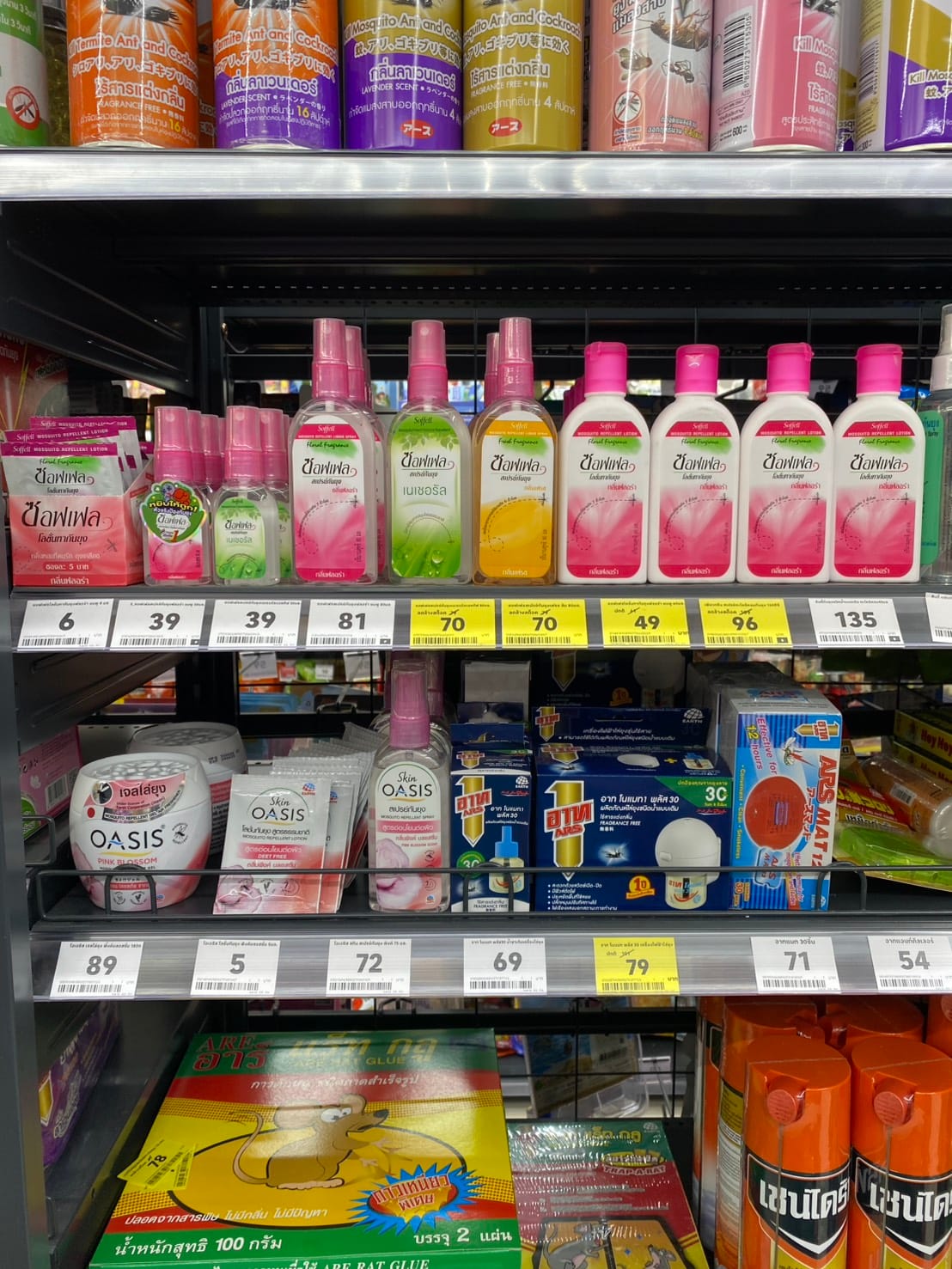
What I can't tell you is your risk of getting ill, and I am not going to estimate it. What I can pass on is what the official advice says, because it is specific and it surprises people. The CDC does not recommend antimalarial tablets for Phuket. Malaria is rare-to-few here and on the other main islands, with prophylaxis advised for the provinces bordering Myanmar, Cambodia and Malaysia instead. Dengue is the one to take seriously, and there is no vaccine that will protect an ordinary traveller from it, so not being bitten is the strategy. The advice is repellent with at least 20% DEET, covered skin, and screened or air-conditioned rooms. (Researched, checked September 2026 — CDC Thailand. Check it yourself before you travel; this is the kind of guidance that changes.)
The practical upshot is small and slightly boring: buy a bottle when you arrive, and put it on the table when you eat outside.
Walking at night
I have never felt uneasy walking alone here after dark.
It is worth separating three things that get flattened into "Phuket at night," because they are not the same place.
The market streets of Old Town stay busy. Families out, food, scooters threading past people on foot, and on a festival evening the flags go up and it fills right out. This is the version of Phuket Town that photographs well and the one visitors see.
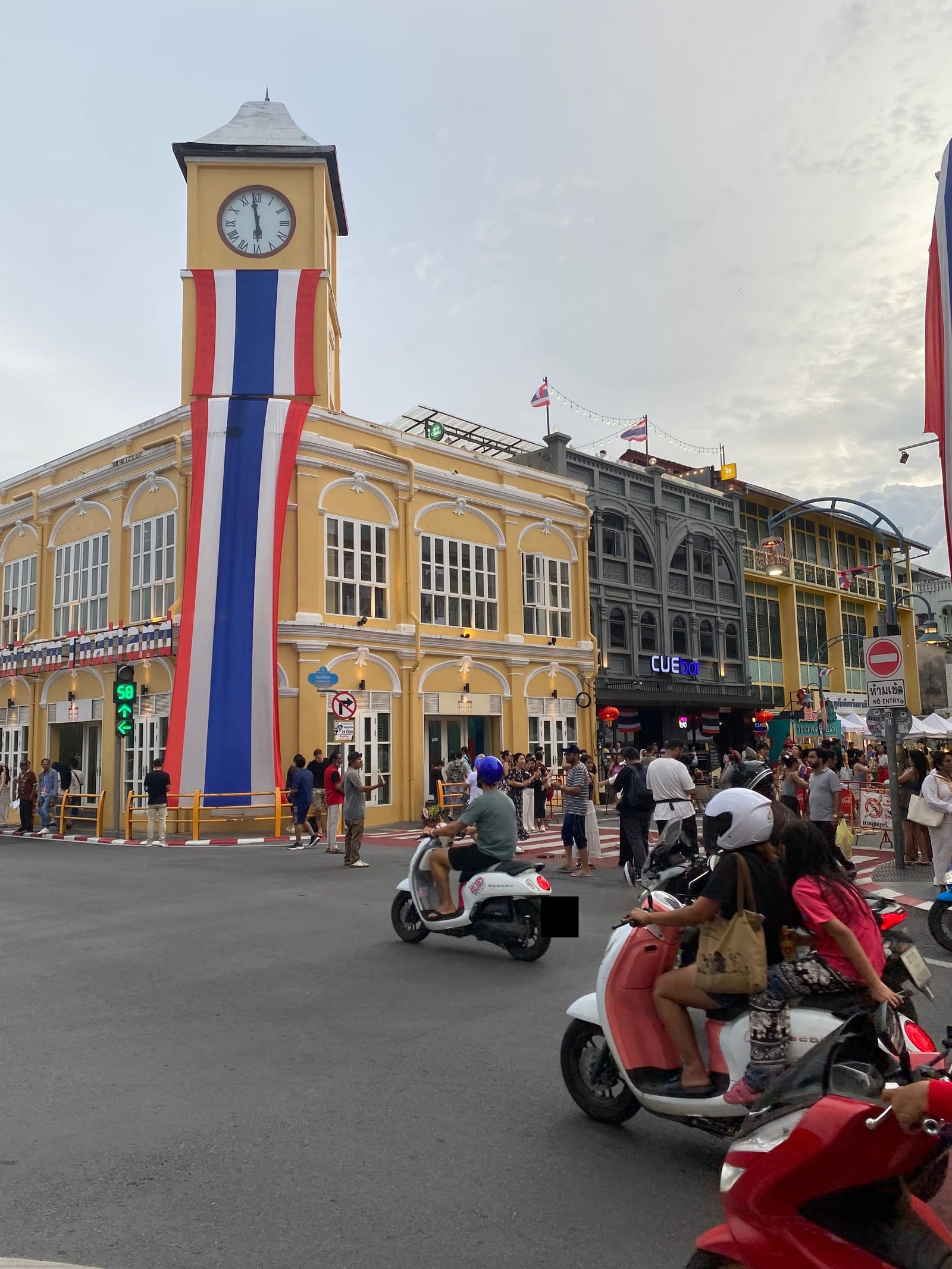
The residential streets go properly quiet. Where I live is much quieter than the Old Town in that photograph — empty pavements, not much moving. That is the ordinary evening for a resident, and it is a different experience from the one a visitor staying near the market gets.
Patong is loud late, in its own way, and stays that way.
None of the three has made me uncomfortable, and I list them separately because at home they would read as signals — an empty street meaning one thing, a crowded one meaning another. Here they have just been descriptions of where you happen to be standing. That is a small recalibration, and it is the sort that comes from living somewhere rather than from a list.
Nightlife and drinks
This part is researched, not lived. The UK government's travel advice says drink spiking happens in tourist areas around Thailand, with male and female victims, and its advice is the plain one: do not leave a drink unattended and do not accept one from a stranger. The crowded late strips are where that advice applies, and on this island that means Patong first.
Add the road to it. Leaving Patong for anywhere else means Patong Hill, and that is not a road to ride after a night out. Take a Grab.
Is it safe for a woman travelling alone?
This is the most-asked version of the question, and it is the one I am least qualified to answer. I am a man living here alone. The part of this question that is different for a woman is the part my experience does not reach.
So rather than pass off my ordinary evenings as an answer, here is the split.
What I can report, because it is about the place rather than about me: being by yourself is completely unremarkable here — nobody registers a person eating, riding or walking alone. The market streets of Old Town stay busy and lit after dark while the residential streets go properly quiet, and Patong is loud late in its own way. Simple English works for ordinary transactions. The lifeguards on the beaches are there and do intervene.
What I cannot report: whether any of that adds up to feeling safe as a woman here, whether unwanted attention is a routine part of a night out, or how the quiet streets I find peaceful read to someone with a different set of things to weigh. I have no data on that, and a page that answered it anyway would be making it up.
Every other page ranking for this question answers it confidently. Notice how many of those authors were here for five days.
The scams I have not had — and how they work
I said above that nothing has been tried on me in two years. That is true and it is also not enough to plan around, because "it did not happen to one resident" is not the same as "it does not happen."
So here is the labelled version. The following is researched, not lived — these are the scams consistently documented for Phuket, including by the US Embassy in Thailand. I have not been through any of them.
- The rental damage claim. You rent a jet ski or a scooter, hand over a deposit and sometimes a passport, and on return you are told you damaged it. The damage is pre-existing, the sum is large, and the situation is designed to escalate. This is the single most-reported Phuket scam. My own experience: nobody has ever tried it on me, and I know of no one here it has happened to — but I still photograph a bike before I ride it, and I would not hand over a passport as a deposit.
- The tuk-tuk detour. A cheap fare that routes you via a gem shop or a tailor, where the pressure to buy is the point and the driver takes a commission.
- Metered taxis that are not metered. Agree the fare before you get in, or use an app.
- Pickpocketing in crowds — beaches, markets, bars. The ordinary version of the risk, and the one my "nothing happened" record says least about, because I am not in tourist crowds often.
The reason I am listing these rather than skipping them: my clean record is reassuring about the baseline, and uninformative about the situations I do not put myself in. A resident's week and a visitor's week are not the same week.
The one thing that catches people out
If I get one warning, I am not spending it on any of the above.
Vapes are illegal in Thailand. Importing them, selling them and possessing them are all offences, and the ban is on the device — it does not matter what is in it, or whether it is empty. Reported penalties run to fines in the tens of thousands of baht with the possibility of imprisonment, and bringing one through customs carries far heavier exposure than being caught with one here. The Royal Thai Embassy's own notice sets out the ban. (Researched and checked 3 September 2026 — this part is not something I have been through, and I am not going to write it as though it were.)
Here is why it is a trap rather than simply a rule.
They are sold completely openly. I see them on the street. "Vapes available" posts turn up on Facebook and in other online listings. Nothing about the transaction looks illicit. There is no back room and no whispering; it looks like buying a phone charger.
So the visitor's reasoning is entirely sensible and entirely wrong: it is being sold in public, therefore it is allowed. The selling being open tells you nothing about the law. It is the widest gap I can point to between how something looks here and what it is, which is exactly why it is the thing I would warn a friend about.
I am not telling you where they are sold, and that is deliberate.
On the two legal figures on this page — the vape ban and the ฿2,000 helmet fine. Thai traffic and customs rules change, and the helmet penalty itself quadrupled in June 2025, so a number that is right today may not be right when you read this. Both were checked on 3 September 2026 against the sources linked above, and neither is something I have been through personally. Verify against a current official source before you act on either — and if a rule has moved, treat the official version as correct and this page as out of date.
Is the food and tap water safe?
Don't drink the tap water. I don't; I buy my water. The CDC's advice for Thailand agrees: drink only from sealed containers. Bottled water is on every shelf.
Food is the easier half. The same CDC page suggests eating at places that cook to order and avoiding raw or undercooked food. Cooked to order in front of you is what most of the street food here is, which is why the food is low on my list of worries and the road is at the top of it. (CDC advice researched, checked 7 October 2026.)
Emergency numbers, hospitals and insurance
Four numbers worth having in your phone before you need them. All four are national and listed in the UK government's Thailand travel advice:
| Who | Number | Use it for |
|---|---|---|
| Tourist Police | 1155 | The line set up for visitors. Scams, rental disputes, lost property — anything where the language is the obstacle. |
| Ambulance | 1669 | Medical emergencies — the national emergency medical line. |
| Police | 191 | Crime and general emergencies. |
| Fire | 199 | Fire. |
The Tourist Police line is the one most visitors do not know exists, and it is the right first call for the situations in the scam list above. A rental dispute is precisely the sort of thing 1155 is for.
Hospitals with a 24-hour emergency department, by their own sites:
- Bangkok Hospital Phuket — private; emergency and trauma centre open 24/7.
- Bangkok Hospital Siriroj — private, the same group; 24-hour emergency centre. In Phuket Town. Older maps and reviews call it Siriroj International or Phuket International Hospital.
- Vachira Phuket Hospital — the island's government provincial hospital. Its site does not state its emergency hours, so I have not written them here.
(Researched from the hospitals' own sites, checked 7 October 2026. I have not been treated at any of them.)
Then the bill. Private hospitals here generally expect payment, or an insurer's guarantee, before they discharge you. I carry no insurance myself, and the reasoning and the sums are in the health insurance guide. That is a resident's bet with a resident's cash cushion behind it. A visitor on a two-week trip is a different case, and travel medical cover is cheap next to that bill.
So — is it safe?
Someone asked me directly whether they would be all right coming here on their own. My answer was: completely fine. You can live here by yourself, and I do not spend ordinary days feeling that anything is dangerous.
I would keep that answer, with two footnotes attached.
The first is that I am reporting two years of one person's experience, not a guarantee about yours, and I have been telling you all the way down this page where my evidence is thin.
The second is the one worth carrying: the island feels calm, and the roads do not deserve that calm. Everything else here rewards relaxing. The traffic is the one place where the general mood of the island is a bad guide to the specific thing in front of you.
Take a helmet, look behind you, and skip the vape.
And if the reason you searched this was not about a holiday — if what you were asking is whether you could be here on your own, for longer — then the safety answer is the easy half of that question. The harder half is what an ordinary Tuesday is like when nobody is expecting you anywhere. I've written about that separately, including the part that is hard, and what a month of it costs is the number people want next.
01What I would and would not worry about
Asked directly whether someone should come here on their own, my answer is yes, without hedging. You can live here alone, and in ordinary weeks I do not feel unsafe. Eating alone, moving around alone and walking home alone are all unremarkable here. That is a report on two years rather than a promise about yours, and it is worth more than the reassurance you will find on pages written after a five-day visit — but it is still one person's.
The gap between how safe the island feels and how the traffic behaves is the thing to hold on to. Because nothing else here demands vigilance, it is easy to extend that calm to a scooter, and the road is where the calm stops being accurate. If you take one thing from this page, take a helmet and a habit of checking what is coming up behind you — and note that I am telling you this as someone who has not had an accident, which means I am describing a risk rather than a scar.
02If you are visiting: the cover to price first
Private hospitals here expect to be paid before you leave, and a bad scooter crash runs to six figures in baht. I carry no insurance myself — why, and the sums behind it — but a visitor without a resident's cash cushion is a different case. The plan travellers here price first is SafetyWing Nomad Essential, about $63 per 4 weeks for ages 18–39. Researched, not a plan I hold — get a live quote for your age, and find the motorbike clause before you look at the price.
Frequently asked questions
- Is Phuket safe for tourists?
- In my experience living here since 2024, yes, and the reasons people worry are mostly not the reasons that matter. I have not been scammed, overcharged in a way I noticed, or robbed, and I have never felt uneasy walking alone at night. What I do treat carefully is traffic. If you want one practical rule from a resident rather than a list of twenty, it is this: be careful on the road, and do not buy a vape no matter how openly they are sold.
- Is Phuket safe for solo travellers?
- Yes, on the evidence of living here alone for two years. Being by yourself is completely ordinary here — nobody registers someone eating or moving around alone — and I have not had a situation where being on my own made things worse. The practical risks that do exist, chiefly traffic, are not made worse by being solo either. Whether you are comfortable being alone is a separate question and it is covered in the living alone guide.
- Is Phuket safe for solo female travellers?
- I am not in a position to answer this one, and I would rather say so than pretend. I am a man living here alone, and the part of this question that is different for a woman is exactly the part my experience does not cover. What I can report is about the place rather than about me: being alone here is completely unremarkable to everyone around you, Phuket Town and the residential streets go very quiet after dark while Patong stays busy and lit, simple English works for ordinary transactions, and the beach lifeguards are there and do intervene. Whether that adds up to feeling safe as a woman, and whether unwanted attention is a routine part of a night out here, I have no evidence on. Most pages ranking for this question answer it confidently — it is worth checking how long those authors were here.
- Which area of Phuket is safest?
- No area has a crime problem I have seen or heard of, so the useful question is which risk each area puts in front of you. Patong and Kata are reached over the island's two hard hills, and Patong is the crowded, loud-late strip where pickpocketing warnings apply. The west-coast beaches all take the monsoon surf from roughly May to October. Phuket Town has no beach and its risk is evening traffic. The area-by-area table on this page labels which rows I have lived and which are researched — only Phuket Town is lived.
- What are the most common scams in Phuket?
- The most reported one is the rental damage claim: you hire a jet ski or a scooter, leave a deposit and sometimes a passport, and are told on return that you damaged it. The damage is pre-existing and the sum is large. After that come the tuk-tuk detour to a gem shop or tailor where the driver takes a commission, taxis that will not use the meter, and pickpocketing in crowds. This part is researched rather than lived — in two years nobody has tried any of it on me, and I know of no one here it has happened to. That says something about the baseline and nothing about the situations I do not put myself in, which is why I list them anyway. If one does happen to you, call the Tourist Police on 1155.
- What is the emergency number in Phuket?
- 1669 for an ambulance, 191 for police, 199 for fire, and 1155 for the Tourist Police — the line set up for visitors, and the right first call for scams, rental disputes and lost property. All four are national numbers, listed in the UK government's Thailand travel advice. I have not had to use any of them, so this is researched, checked 7 October 2026, rather than something I can describe from the other end.
- Which hospital should I go to in Phuket?
- For an emergency, the two private hospitals whose own sites state a 24-hour emergency department are Bangkok Hospital Phuket and Bangkok Hospital Siriroj. Vachira Phuket Hospital is the island's government provincial hospital. Private hospitals generally expect payment or an insurer's guarantee before discharge. I have not been treated at any of them — when I have been ill I have looked after myself at home — so this is researched from the hospitals' own sites, checked 7 October 2026.
- Can you drink the tap water in Phuket?
- No. The US CDC's advice for Thailand is not to drink tap water and to drink only from sealed containers. Bottled water is on every shelf. Food from stalls that cook to order is the CDC's own suggestion for eating safely, which describes most of the street food here anyway. Researched, checked 7 October 2026.
- Is it safe to walk around Phuket at night?
- It has been for me, and I do it. The thing worth knowing is that "Phuket at night" is three different places. The market streets of Old Town stay busy with families, food and scooters, and fill right out on a festival evening. The residential streets where I live are much quieter than that, with empty pavements and little moving. Patong is loud late in its own way. I have not felt uneasy in any of the three, but note that quiet and busy are descriptions of where you are standing here, not signals of danger in the way they might read at home. A visitor staying by the market and a resident on a side street are having different evenings.
- Do I need to wear a helmet in Phuket?
- Yes, and the reason is more immediate than the one you would expect. Riding without one draws police attention — you get pulled up for it and it comes up at checkpoints — and since 1 June 2025 the fine has been up to ฿2,000, four times the ฿500 it used to be. Passengers must wear one as well, and a rider carrying a bare-headed passenger can be penalised for both. My rough estimate is that about eight in ten people here wear one, and plenty of locals do not. The crash argument holds too, but the enforcement is the part you will feel first. (Fine figures researched and checked 3 September 2026 — I have not been fined myself.)
- Are the roads dangerous in Phuket?
- This is the part of the safety question I would take seriously. Two situations stand out from riding here. Cars come up behind you fast, and if you are riding in the middle of the lane you will get horned at. And in the evening, when the lights back up into a proper jam, bikes filter through the gaps between stopped cars — the contact risk there is bike-to-bike rather than car-to-bike, and it is the one that makes me pay attention. One rule that catches visitors out: turning left on a red is normal here, so traffic keeps moving through a red light in a way it would not at home.
- Can you swim in Phuket during monsoon season?
- Not when the red flag is up, and the flag is not decorative. On the red-flag afternoon I photographed at Karon, people were in the water — but only ankle-deep, and the lifeguards moved anyone who tried to get out past the break. My own rule is simpler than reading the surf: on a red-flag day I do not go in at all, and I look at the sea from the dry sand. Month-by-month conditions are in the when to visit guide.
- Is there a tsunami risk in Phuket?
- Thailand's Andaman coast is exposed to tsunamis, which is why Phuket's west coast carries warning towers run by the National Disaster Warning Center, part of the government's Department of Disaster Prevention and Mitigation. If a warning sounds, the instruction is to move inland and uphill rather than to wait and watch the sea. I have not been through a warning, so this is researched, checked 7 October 2026.
- Are vapes legal in Thailand?
- No. E-cigarettes and vaping devices are banned in Thailand — importing, selling and possessing them are all offences, and the ban applies to the device regardless of what is in it. Reported penalties run to fines in the tens of thousands of baht and possible imprisonment, with far heavier exposure for bringing one through customs. What makes this a trap rather than a rule is that they are sold openly here — on the street and in online listings — so it looks like a legal purchase. I would simply not buy one. This part is researched rather than lived; I have not been through it and I am not going to pretend otherwise.
- Is theft a problem in Phuket?
- Not in my experience and not in anything I have heard locally. My building has an auto-lock entrance and I know of no theft in it. That is an absence rather than proof, and a resident of one building is a small sample — but it is a better answer than repeating a generic warning I have no evidence for.