Phuket · Getting around
Renting a Scooter in Phuket (2026): A Resident's Honest Guide
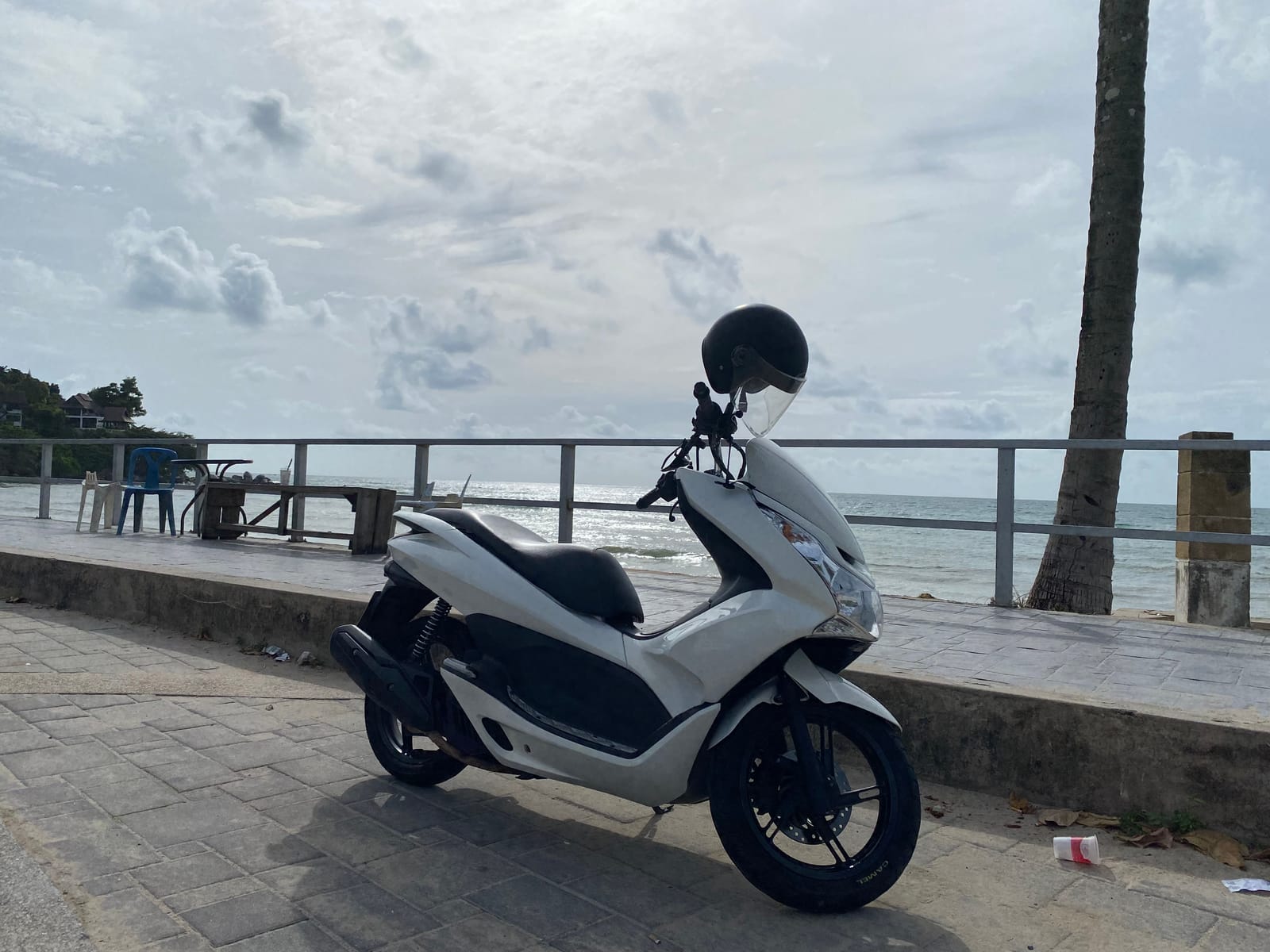
I've ridden here since 2024 on a used PCX I bought for ฿20,000. Renting is cheap and easy — the catch is the licence and insurance, and if you buy, the green book. Here's the honest read, with real baht and the mistake that cost me.
- Rental, per day
- ≈ ฿250–350
- Rental, per month
- ≈ ฿3,000–5,000
- What I ride
- Used PCX · ฿20k
- The real catch
- Licence + green book
Renting a scooter in Phuket is cheap and easy — about ฿250–350/day, less by the month (researched, Aug 2026). The rate isn't the catch. You legally need a motorcycle licence, or an IDP with the motorbike (A) category — a car licence doesn't cover you — and riding unlicensed can void your travel insurance if you crash. Phuket's checkpoints target unlicensed foreigners (I get waved through on my Thai licence; the unlicensed get fined). And if you're tempted to buy a cheap used one like I did — a ฿20,000 PCX off Facebook — the real trap isn't the bike, it's the green book: get it transferred into your name at handover, or you'll be stuck like I was.
Every scooter-rental blog quotes you a daily rate and stops there. The rate is the easy part. I've ridden a scooter in Phuket since 2024 — I actually bought one rather than rent — and the things that bite aren't on the price list: the licence rule that voids your insurance, the checkpoints that pull over foreigners, and, if you buy, the green book that can turn a cheap bike into a lasting headache. This is the honest version, with real baht checked August 2026 and the mistake that cost me.
I'm Kai Nakamura, in Phuket since 2024, based in Old Town — which has no beach, so a bike here isn't a holiday toy, it's how I reach one. I hold a Thai motorcycle licence, I ride a used Honda PCX I paid ฿20,000 for, and — full honesty — I ride uninsured. So treat the rental numbers below as researched market rates (I bought, so I didn't rent long-term), and the licence, checkpoint and buying parts as what I've actually lived.
How much does renting a scooter in Phuket cost?
Short version: cheap. A basic automatic runs about ฿250–350 a day in town — you might spot rates advertised as low as ฿150, but I don't see them often — and the longer you take it the less you pay per day — a month is roughly ฿3,000–5,000 for a small automatic (researched, checked Aug 2026). I bought rather than rented, so these are the rates I see quoted and watch friends pay, not a bill I paid — a starting point; the shop and the season move it. (On season: the months you ride in matter for more than price — sudden downpours and wet roads are a real part of the monsoon, and which month you come decides how much of that you get.) Two Phuket-specific notes: airport pickup counters cost far more (about ฿350–600/day for the convenience), and many town shops deliver to your hotel free on longer rentals — so grabbing a bike at the airport desk is the expensive way to do it.
| What you rent | Per day | Per month | Good for |
|---|---|---|---|
| Honda Click / Scoopy (110–125cc) | ฿250–350 | ฿3,000–5,000 | Town hops, one rider, flat roads |
| Honda PCX / Yamaha NMAX (150–160cc) | ฿300–400 | ฿4,000–6,000 | Phuket's hills, two-up, longer rides |
| Bigger / maxi scooter (Forza, XMAX) | ฿600–1,800 | ฿10,000+ | Confident riders who want comfort |
Finding a bike is never the hard part — rental shops line every tourist area, and most hotels will point you to one or arrange delivery. What matters is what happens at the shop: the deposit and the damage. Many shops ask for a cash deposit (around ฿1,000–3,000) or your passport — and here's the one firm rule I'd give anyone: don't leave your actual passport. Offer the cash or a photocopy; a shop that insists on holding your real passport has leverage over you in any argument about a scratch. Before you ride off, photograph every existing scuff and dent — front, back, both sides — so a pre-existing mark doesn't quietly become your bill on return. And don't be reassured by "insurance included": on most rentals it isn't real cover — you're still liable for damage or theft, your cash deposit is effectively the excess, and true zero-excess cover is rare here.
Which scooter should you actually get?
For flat riding around town, a Click or Scoopy (125cc) is plenty and sips fuel. But Phuket is hillier than people expect — the headlands between the west-coast beaches are proper climbs — so if you'll ride two-up or take on the hills to Kata or Kamala, a PCX or NMAX (150–160cc) is the one to get — and since a 125 and a 150 rent for much the same here, choose on capability, not price. A 125 with two adults aboard genuinely labours up those hills. That's a firsthand call: I ride a PCX for exactly this reason.
But there's a bigger choice than engine size, and it's the one I got wrong at first. When I started looking I wanted something that looked good — a geared, manual bike, the dirt-bike / trail style. Then I asked around, and locals all told me the same thing: almost nobody services those here. Unless you're a bike person who can spanner it yourself, keeping a manual or an uncommon model running in Phuket is a constant hunt for a shop that'll even touch it. The plain automatic scooters — a Honda PCX, a Yamaha, the common stuff — are the opposite: every little shop on every street fixes them. A battery swap, a tyre change, a service — anyone does it, and it's cheap. That's why I ended up on a PCX, and why I'd tell anyone staying a while to do the same. The real question isn't 125 versus 150 — it's whether you pick looks or serviceability. On this island, choose the boring, common scooter you can actually keep on the road.
Do you actually need a licence to ride in Phuket?
Legally, yes — and this is where most visitors get it wrong. To ride a scooter legally and insured you need either a Thai motorcycle licence, or an International Driving Permit (IDP) that includes the motorcycle category (A) — and your home licence has to carry that motorbike entitlement in the first place. A car licence, or a car-only IDP, does not cover you on a scooter — not even a little automatic. One practical catch: sort the IDP before you fly — you get it from the licensing authority in your own country, and you can't pick one up in Thailand on a foreign licence. And if you're moving here rather than visiting, the IDP is a stopgap: the resident's answer is a Thai motorcycle licence, which costs about ฿700–1,000 and a day of your life.
Rental shops rarely check — they want the rental — so it's easy to assume you're fine. You're not. The two places it bites are a police checkpoint and, far worse, a hospital: an unlicensed rider's insurance claim can be refused after a crash, leaving the bill yours. I hold a Thai licence, which is exactly why checkpoints are a non-event for me. If you want the official word on licences and registration, it's the Department of Land Transport — and if you're here long enough that the IDP clock runs out, here's how I actually got my Thai motorcycle licence, theory test I failed three times and all.
What do Phuket's checkpoints actually check?
Here's the law-versus-street reality you only learn by living here. Phuket runs frequent roadside checkpoints, and I've been waved down and asked for my licence more times than I can count — I show my Thai licence and ride on. What they're really hunting is unlicensed riders, and foreigners in particular. What they mostly don't stop you for, in my experience, is no helmet — half the island rides bareheaded and the checkpoints let it slide.
Don't read that as permission. Wear a helmet every time — the reason isn't the fine, it's your skull; a low-speed slide on sand or a diesel patch can still put you in hospital. That goes for your passenger too — a pillion rider needs a helmet, and the fine applies to them as well. On paper a no-helmet fine can now reach ฿2,000 (raised in 2025) and riding with no valid licence runs around ฿1,000, sometimes more, with the bike held until you produce papers (researched, checked Aug 2026 — rules and enforcement change, so verify before you ride). But the honest street reality is that on foreigners here, the licence is what gets enforced — and it's the one that also voids your insurance, so it's the one to get right.
Is it cheaper to buy a scooter instead?
If you're staying months, the maths tips toward buying. A month of rental (฿3,000–5,000) against a used bike at ฿15,000–30,000 pays back fast — I paid ฿20,000 for my used PCX, found on Facebook (the local buy-and-sell groups are where the cheap ones hide; dealer lots cost more). And there's good news for foreigners: there's no nationality bar on owning a bike in Thailand — your name can go in the book, unlike with land.
But here's the trap that actually caught me, and it's the whole reason I'm careful telling anyone to buy. The bike is only really yours once the "green book" — the registration book, tabien rot — is transferred into your name. That transfer needs the seller's cooperation: their signed ID copy and the transfer form, plus a signed power of attorney if they can't come to the land-transport office with you. Early on here, I bought a bike from someone I then couldn't reach again — no signed papers, no power of attorney — and I got stuck: the book could never go into my name.
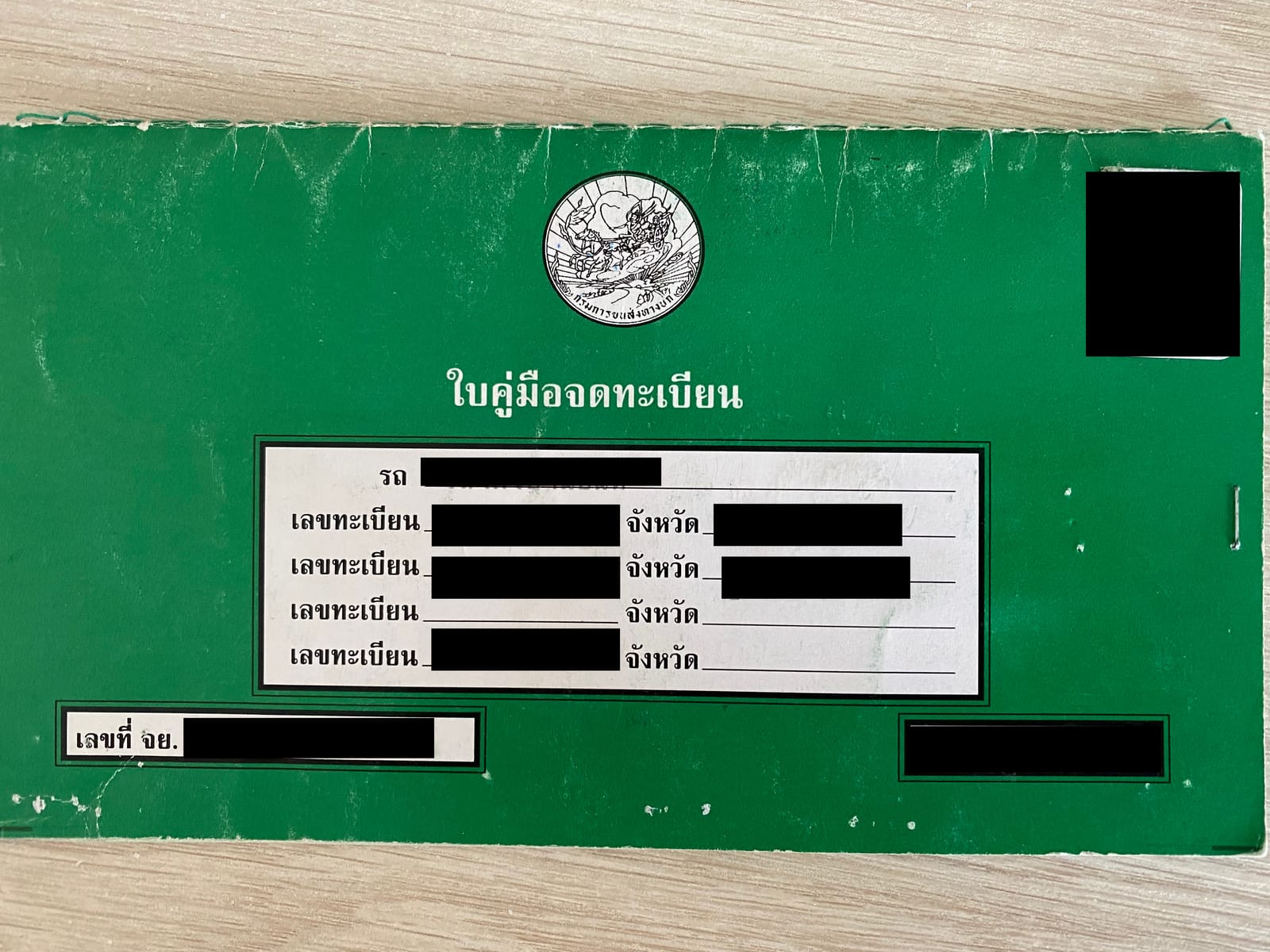
And it turned out to be worse than an ownership technicality. Online you'll read that it doesn't matter whose name is in the book — you can still tax the bike anyway. That was not my experience in Phuket. At the Phuket inspection centre, the name mismatch meant I couldn't get the bike through its inspection — and without that certificate you can't renew the road tax the normal way. So the trap isn't abstract: a bike you can't transfer can become a bike you can't easily keep legal, and one you can never sell on, because you can't sign it over to the next buyer either.
That mistake taught me the one rule I don't break now: get the green book transferred at handover, or don't hand over the cash. Do the transfer together at the Department of Land Transport — the seller's ID copy and signed transfer form, and your passport plus a proof of Thai address (a Certificate of Residence from Immigration, a yellow house book, or a work permit). The fees are small: the transfer itself is roughly ฿100–300, plus compulsory insurance (por ror bor) about ฿400 a year for a 150cc and road tax roughly ฿100–300 a year (researched, checked Aug 2026; verify at the DLT — figures and paperwork change). Buying well is its own skill, but that single rule is the one that matters — it's a line item in my cost-of-living guide, and the paperwork is the part that decides whether it was a bargain.
What's riding in Phuket actually like?
A few things nobody warns you about. The rain: in green season the squalls arrive in minutes and hit hard — ponchos cost small change at any 7-Eleven, so I keep a couple stashed under the seat, always; get caught without one and you're soaked through in ten minutes or stuck under a 7-Eleven awning waiting it out. The traffic: Phuket's roads clog badly in the late afternoon, and a bike is often the difference between 15 minutes and an hour — that's the real reason to ride here. Fuel is cheap: topping up my PCX is a matter of tens of baht, at a station or one of the roadside bottle stands when you just need a quick litre — which pump to use is its own small puzzle, and one nobody warns you about either. And the honest safety line: the stretches that scare me are the fast, sandy coastal curves and anything at night after the bars empty out — ride sober, ride visible, and treat every pickup truck as if it hasn't seen you.
Which fuel do you put in?
Nobody warns you about this one either, and it arrives about an hour into your rental. You pull into a station, and there is a row of nozzles labelled in Thai script, an attendant walking towards you, and no obvious way to know which one your bike takes.
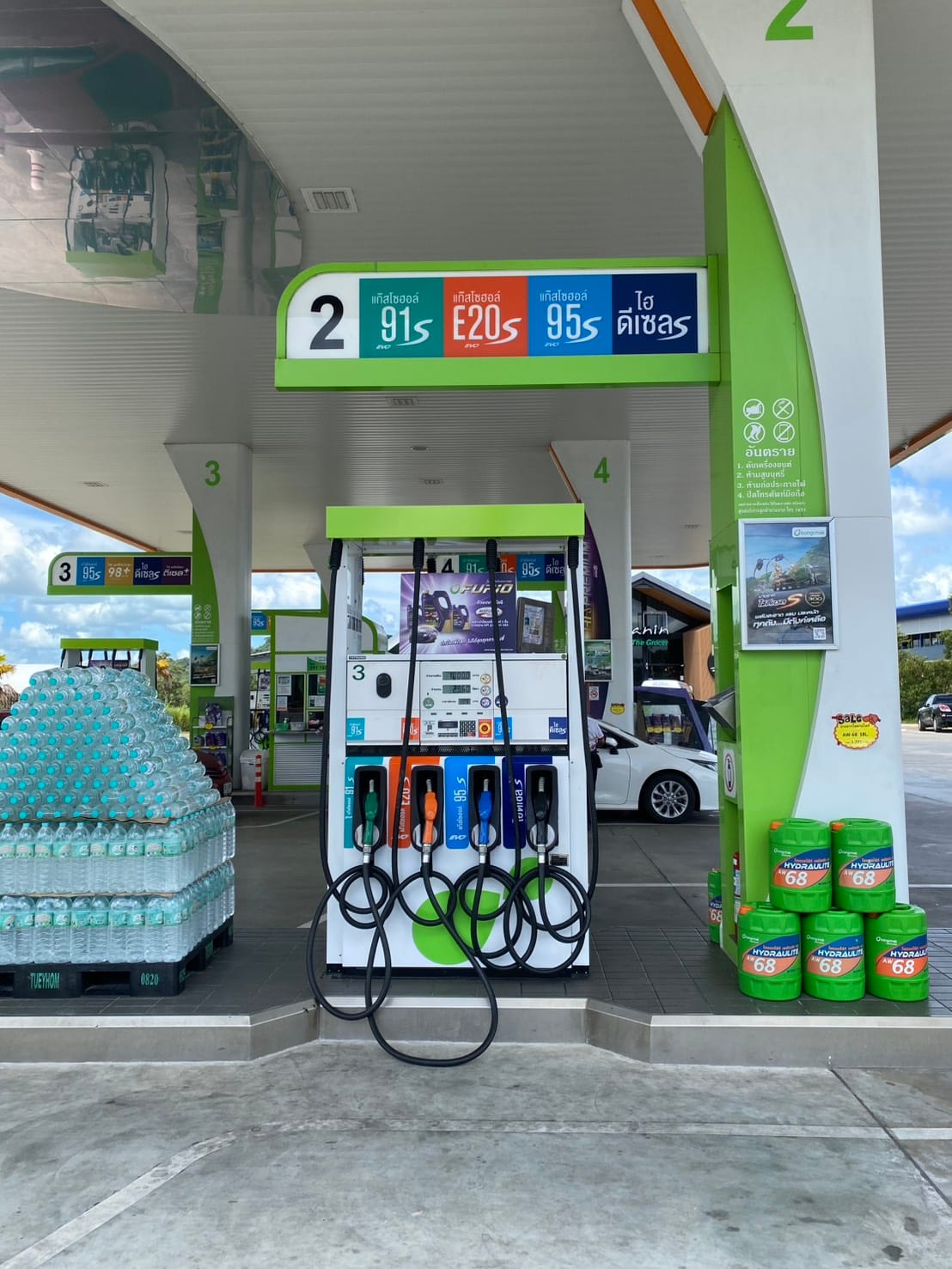
The first thing to know is that you do not choose at the nozzle. Thai stations are full service — you stay on the bike, and the attendant fills it. The whole transaction is two pieces of information: the grade, and how much. "Gasohol 95, one hundred baht" does it, or dtem tang (เต็มถัง) for a full tank. Cash, card and Thai-bank QR are all normal.
Which grade? For a scooter, Gasohol 95 is the answer that is never wrong, and it is what I would tell anyone on a rental to say. Gasohol 91 is also fine and costs almost the same, so the saving is not a reason. E20 is about ฿5 a litre cheaper — but only take it if the bike is rated for it, because ethanol is hard on older fuel systems and a rental scooter is often exactly the old bike that suffers: corrosion, hard starting, running hot. E85 is for flex-fuel vehicles and no scooter is one. Diesel is a different machine entirely. (Grades and prices researched, checked September 2026 — Bangkok basis; Phuket runs slightly higher.)
What I actually run, for whatever it is worth: 95, or 91. Two years, the same bike, no trouble either way — and I could not tell you which of the two went in last, because I have never needed to care. That is the honest version of the advice above. The gap between those two grades is small enough that a resident stops tracking it; the gap that would matter is putting in something the bike isn't rated for, and neither of these is that. I don't take the E20 saving, and I am not going to pretend I calculated that decision.
The advice everyone gives is to check the sticker on the fuel cap, and I want to be straight that it did not work for me. That is the method Thai press puts first, and on a car it is sound. My own bike has no such sticker. So if yours hasn't either, you are not missing something — ask the shop what the bike takes when you collect it, and say 95 in the meantime.
One reason to check the date on any page telling you this, including mine. Thailand is restructuring its road fuels: Gasohol 91, Gasohol 95 and E85 are all being discontinued in favour of E20, with completion targeted for 2027. A list of six grades is already a decaying fact. (Researched, checked September 2026.)
What if you come off the bike?
If you ride alone, add one habit first. Nobody is expecting you home. On a long ride, tell one person which way you're going, or leave location sharing on with them — it costs nothing, and it is the cheapest thing a solo rider can do. A bike is what makes the island reachable on a whim instead of by appointment — which is most of why people end up with one. The flip side of nobody scheduling your day is nobody noticing you didn't come back.
If you crash, get to a private hospital — better care, and it's where your insurance works if you carry it. Keep any police report for a claim. And know the hard part: if you were riding unlicensed, the claim can be refused and the costs are yours. This is the whole reason the licence and insurance aren't box-ticking. To be clear, going without your own medical cover isn't illegal here — it's a financial gamble, not a crime; the bike's compulsory third-party insurance (por ror bor) is the separate, legally-required bit. I ride uninsured myself — honestly, and a little nervously — and I've written separately about that gamble and what cover actually costs here. Whatever you decide, decide it on purpose, not by accident.
01Should you ride a scooter in Phuket?
If you ride at home and you'll be here more than a couple of days, rent (or buy) — it's the best way around a traffic-clogged island, and it's cheap. About ฿250–350 a day, a bike beats an hour in a Grab queue, and it opens up the quiet south and east coasts. Bring or get the motorcycle (A) licence, wear a helmet — the fine for going without has been ฿2,000 since June 2025, and [what the roads here are actually like](/guides/is-phuket-safe) is the part worth reading before you ride — and it's a genuine yes.
Don't learn to ride here. Phuket has real hills, monsoon downpours, sand on the curves and some of Thailand's worst road-accident numbers — a tourist island is the wrong classroom. If you've never ridden, or you have no motorcycle licence, the honest move is to skip the scooter: use Grab or a private driver. No rental saving is worth an uninsured hospital bill.
02The catch that costs the most: insurance
Riding is the single most likely way a visitor lands in a Phuket hospital — and most travel policies won't pay out if you were riding without the right licence. I ride uninsured myself, and I'm honest that it's a gamble. If you want cover, SafetyWing covers motorbike accidents when you hold a valid licence; if you'll ride a ≤125cc without a motorcycle licence, only a few insurers cover you at all (researched — Genki is the name that comes up). Get a quote for your age, and read [my full take on going uninsured in Phuket](/guides/health-insurance-phuket) first.
03Don't want to ride? The honest alternative
No shame in skipping it. If you're not confident on two wheels — or you've got luggage, kids, or a big first-day arrival — a private transfer or a driver for the day is the calm option, and often barely more than a metered taxi once you'd have paid for a rental plus fuel. It's what I'd book for an airport run with bags rather than wrestle a scooter and a suitcase. For the everyday version of that decision — what I actually use once I'm here, and the one weather condition that changes the answer — see [getting around Phuket](/guides/getting-around-phuket).
Frequently asked questions
- Do you need a licence to rent a scooter in Phuket?
- To ride legally and stay insured, yes — you need either a Thai motorcycle licence or an International Driving Permit that includes the motorcycle category (A), backed by a home licence that carries that motorbike entitlement. Rental shops rarely check and will hand you a bike anyway, but a police checkpoint will check, and — more seriously — an unlicensed rider's insurance claim can be refused after a crash.
- Can I ride a scooter in Phuket on my car licence or a car IDP?
- No. A car licence, or an IDP that only covers cars (category B), does not legally cover you on a motorbike — not even a small automatic scooter. You need the motorcycle (A) entitlement. This is the most common and most expensive misunderstanding, because it's also what voids your travel insurance.
- How much does it cost to rent a scooter in Phuket?
- Roughly ฿250–350 a day for a small automatic in town — you might see cheaper rates advertised, but they're uncommon — with airport pickup counters dearer, dropping to about ฿3,000–5,000 a month for a longer rental (researched, checked Aug 2026). A bigger PCX or NMAX runs a little more. Season and the individual shop move the price, and Phuket is pricier than the Thai mainland.
- Should I leave my passport as a deposit for a scooter rental?
- I wouldn't. Offer a cash deposit (around ฿1,000–3,000) or a photocopy instead. A shop that insists on holding your actual passport has real leverage over you in any dispute about damage — treat it as a reason to rent somewhere else. Always photograph every existing scratch before you ride off.
- What do Phuket police checkpoints actually check?
- In my experience they mainly check licences, and they pull over foreigners in particular — I've been stopped many times and just show my Thai licence. Riding with no valid licence is still the one that voids your insurance, so it remains the expensive mistake. On helmets I've revised what I wrote here in August: the penalty for riding without one went to ฿2,000 on 1 June 2025, four times the old ฿500, and my current read is that it does get raised — you get pulled up for it, and it comes up at checkpoints. Plenty of local riders still go bareheaded; my estimate is about eight in ten people wear one. Wear one. The crash argument is the real one, but the fine is the one you'll feel first — more in the [safety guide](/guides/is-phuket-safe).
- Is it safe to ride a scooter in Phuket?
- It can be, if you already ride — but Phuket is not the place to learn. Thailand has some of the world's worst road-accident figures, and the island adds hills, sudden monsoon rain, sand on coastal curves and unpredictable traffic. Ride sober, wear a helmet, avoid riding at night after the bars empty, and don't take a bike out for the first time in your life here.
- Does travel insurance cover motorbike accidents in Thailand?
- Often only if you hold the correct licence (motorcycle category) and wear a helmet — many standard policies exclude motorbike accidents otherwise, which is how riders end up personally liable for a big hospital bill. Check your policy's motorbike clause before you ride, and see my Phuket insurance guide for the honest version.
- Can foreigners buy a motorbike in Thailand and get the green book?
- Yes — there's no nationality restriction on owning a vehicle (unlike land), so a foreigner's name can go in the green book. You register the transfer at the Department of Land Transport with your passport plus a proof of Thai address (a Certificate of Residence from Immigration, a yellow house book, or a work permit). The catch is getting the seller's cooperation to transfer it — see below.
- Is a 125cc scooter enough for Phuket?
- For one rider on flat town roads, yes — a 125cc Click or Scoopy is plenty and sips fuel. But Phuket is hillier than people expect, and if you'll ride two-up or tackle the climbs between the west-coast beaches, a 150–160cc PCX or NMAX is the one to get; a 125 and a 150 rent for much the same here, so choose on capability, not cost — and a 125 with two adults labours on those hills.
- Should I buy a manual motorbike or an automatic scooter in Phuket?
- Go automatic — a Honda PCX, Yamaha or similar. It's not about the ride, it's maintenance: every small bike shop on the island services common automatic scooters, so a battery swap, a tyre change or a repair is quick and cheap almost anywhere. Geared or dirt-bike-style manuals look cooler, but very few shops here will touch them, so unless you can maintain it yourself you'll struggle to keep one running. I wanted a manual at first and gave up on it for exactly this reason.