Phuket · Living here
Renting a Condo in Phuket (2026): One Week, ฿75,000 Down, and ฿0 to the Agent
Every guide tells you which areas are nice. None of them tells you that ฿50,000 of your move-in cash is refundable, that the agent driving you to viewings is paid by the landlord, or what your own lease quietly puts on you when a light dies. Mine does all three — so here it is.
- Move-in cash
- ฿75,000
- Refundable part
- ฿50,000
- What I paid the agent
- ฿0
- Hotel I booked
- ~1 week
Shortlist online before you fly, book about a week of accommodation, and do the viewings and the signing inside it. That is what I did: I picked candidates while still in my home country, messaged an agent from there, landed, was driven to three viewings, and signed a 12-month lease. Move-in cash was ฿75,000 — but only ฿25,000 of that is gone: it was a ฿50,000 refundable deposit plus the first month's rent, which is the ordinary two-plus-one shape here. I paid the agent nothing, because in Thailand the owner pays them — which is also the single most useful thing to understand about the person showing you around. The whole thing ran in English.
I'm Kai Nakamura, and I've rented the same condo in Phuket Town since 2024 — ฿25,000 a month, inland, no beach, pool and gym, internet in the rent. This is the walkthrough of how I got it: what I did before I flew, what the week on the island looked like, what left my account, and what my lease actually says. I re-read that lease on 23 August 2026 to write this, rather than trusting my memory of it — which turned out to matter, because my memory of the deposit was wrong.
What's firsthand and what isn't. The move, the viewings, the money and every clause quoted below are mine — one real lease, which is a strong data point and a poor basis for a generalisation, so I say "my lease" and not "the standard lease." Market rates, agency fee structures and what is normal across Thailand are researched, checked August 2026. Where the two disagree, I'll tell you.
Do you search before you fly, or after you land?
Both — and the order is the whole trick.
I built a shortlist online while I was still in my home country, messaged an agent from there, and had viewings arranged for after I landed. So the sequence was never arrive, wander around, hope. It was:
- Shortlist remotely. Property portals do this job well. I used FazWaz, found through a plain Google search — not a referral, not a walk-in at a shopfront, not a Facebook group. (Facebook groups genuinely are where the cheapest deals hide — that's where I later found my ฿20,000 bike — but for a home, at a distance, in a language you may not read, a portal with an agent attached is the calmer route.)
- Contact the agent before you fly. This is the step people skip. Messaging ahead is what turns a week on the island into three viewings instead of three days of emailing.
- Book about a week. More on this below — it's insurance, not sightseeing.
- Land, view, decide, sign, move in, inside that week.
Why not just do it all remotely? Because photographs don't tell you the things that decide whether you'll be happy: what the corridor smells like, whether the lift is slow, how far the actual walk to a supermarket is, what the road outside sounds like at 7am. Never sign a year from a gallery. The remote half narrows the field; the room tells you the answer.
What to check while you're standing in it
Photos and floor plans cover the layout. These are the things you can only settle in the room, and the first one is worth real money:
-
Who bills you for electricity? Mine comes directly from PEA, the provincial utility — a government bill in my name, ฿1,019 for June 2026 with the air-con on most nights. That matters because some buildings bill tenants themselves at their own rate rather than passing through the utility's, and you won't see the difference until the first invoice. Ask which one it is, and ask to see a recent bill for the unit. What the bills actually come to, and what a landlord is allowed to charge, is its own guide.
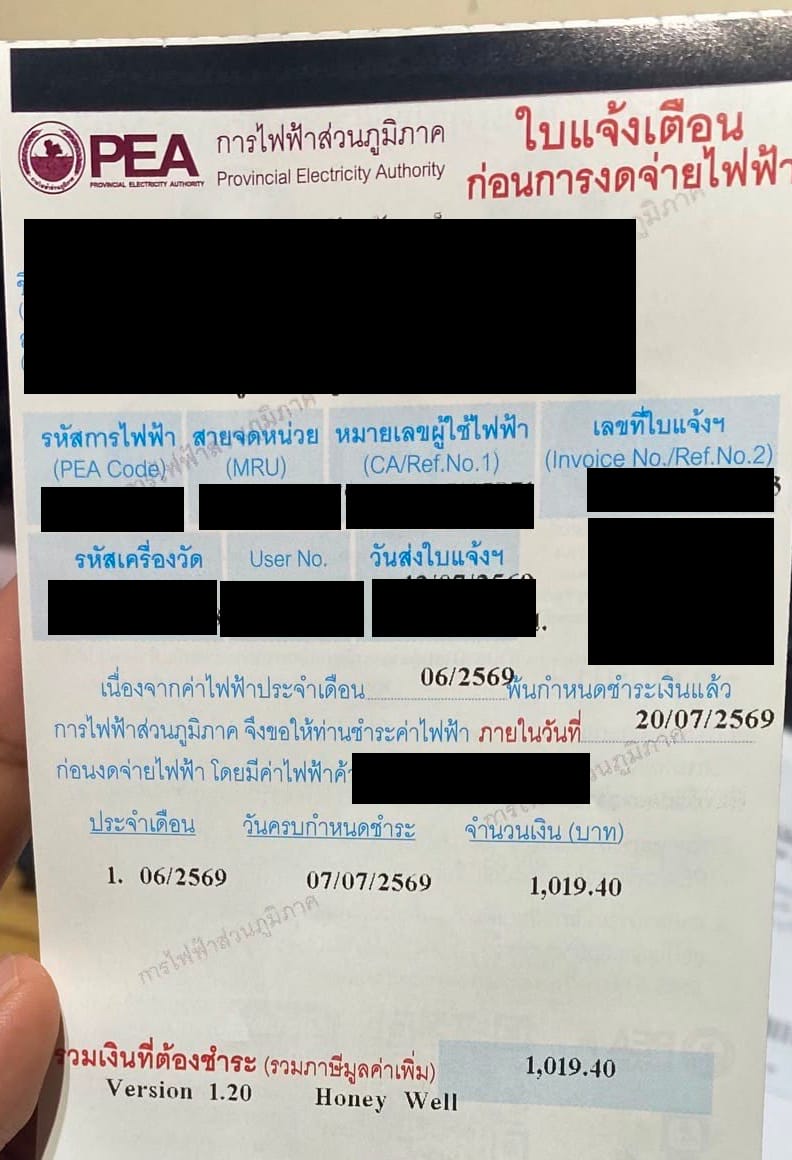
My June 2026 electricity bill — ฿1,019.40, billed by PEA directly rather than by the building. Ask to see one of these for the unit before you sign. -
Is internet included, or a separate line — and if it isn't, will they include it? Mine is in the rent, but it didn't come that way: the unit had no internet and I asked for it to be part of the deal. They agreed. It's a True line, and on True's own price list buying it myself would run about ฿900 a month with VAT — so that one question was worth roughly ฿10,000 a year. Ask; don't assume either way.
-
How old is the air-conditioning, and when was it last serviced? It's the appliance that runs hardest here and the one you'll miss most when it fails. My lease made servicing it the owner's job before move-in — ask for that in writing rather than as a promise at the viewing.
-
What does the lease put on you when something breaks? Ask for the actual document, not a summary. Mine has a ฿2,000 line I'll come back to below, and it's the clause that most often surprises people.
-
The unglamorous stuff: water pressure on the top floor, whether the lift is slow, what the road sounds like early, how far the real walk to a supermarket is, whether pets or smoking are barred by the contract rather than by preference.
How many places should you see? I saw three. That's fewer than most people expect, and it worked because the shortlist had already done the filtering. If you turn up without one, three viewings is not a decision — it's a coin toss with extra steps.
What does it actually cost to get in the door?
฿75,000, on a ฿25,000 rent — and the useful part is that it is not one number.
| At signing | ฿ | Do you get it back? |
|---|---|---|
| Security deposit | 50,000 | Yes — refundable within 30 days of the lease ending |
| First month's rent | 25,000 | No — it's rent |
| Agency fee | 0 | — (there wasn't one) |
| Total liquid on day one | 75,000 | ฿50,000 of it is still yours |
That is a lot of baht to have ready at once, which makes how you convert money a bigger question than it looks — a few percent on that sum is real money. And before any of it, what that budget buys in each area is the decision it all rests on.
Two months' deposit plus one month up front is the ordinary shape here (researched, and it matches my lease exactly). So the practical rule: budget three months of the rent, and know that two of them are a bond, not a cost.
That distinction is missing from every cost-of-living page I've read, mine included until I re-read the contract. It matters twice over — once because ฿50,000 is a lot of money to mistakenly write off, and once because it gives you something to measure an offer against. If a landlord wants materially more than two-plus-one, that's not the Phuket market, that's that particular deal, and you're allowed to say so.
My lease also spells out something worth checking in yours: the deposit cannot be applied as advance rent. You can't decide to live out your last two months on it.
One thing changes if you're doing this alone. ฿75,000 is the whole number, not half of it — a couple splits move-in cash and splits the rent, and the place you can afford solo is simply the place you can afford. It also means nobody else was in the room when I decided. Three viewings, one opinion, one signature, and a year of consequences that belong entirely to me. I don't think that's a reason to hesitate; it's a reason to do the unglamorous half properly, which is exactly why I shortlist before I fly and read the lease instead of the summary of it. What else runs differently when nobody else is involved is its own question.
What isn't in that table: utilities. Electricity, water and internet are on me — though internet ended up inside my rent, and that is the one thing on this page I'd tell you to copy directly. The flat didn't come with it. I asked for it to be included as a condition of signing, and they said yes. A True line at that speed is about ฿900 a month on your own, so asking a single question moved roughly ฿10,000 a year — and the worst case was that they said no. (What that line actually delivers, measured, is in phone and internet in Phuket.) The full monthly picture, with 17 months of my own records behind it, is in what living in Phuket actually costs.
Do you need Thai to rent here?
No. My entire transaction — enquiry, viewings, negotiation, signing — ran in English, and the agent spoke English.
Worth being precise about why that's useful evidence: English isn't my first language either. So this isn't a native speaker reporting that people understood him. It's an ordinary working level of English being enough to view three properties, ask questions and sign a twelve-month contract.
My lease was written in English with a Thai translation alongside, and it states that the English version prevails in any dispute — normal for foreigner-facing rentals, and worth confirming in yours before you sign, because a contract that only exists in Thai is one you cannot actually read.
Who does your agent actually work for?
Here is the thing nobody tells you, and it's the most useful sentence in this article.
The agent works for the owner. In Thailand the agency fee is paid by the property owner — researched, and every Thai agency I could check says the same. I paid mine nothing. That doesn't make it free in the abstract: the owner's cost has to live somewhere, and where it lives is the asking rent. It just never reaches you as a bill.
Now hold that against what actually happened: the agent collected me from my hotel by car and drove me to the viewings. Two years on, I still deal with the agency rather than the owner — repairs, questions, anything. They're my only human contact in the whole arrangement, and they've been genuinely good at it.
Both of those things are true at once, and the honest version says both. It was real, welcome help — and it's a sales process funded by the other side of the table. Not a scandal, not a warning to be suspicious; just the structure. Knowing it changes small decisions:
- When the agent says a price is firm, that's a party with an interest in the price talking.
- When something breaks and you're offered "we'll send a technician" — as I was — arranging maintenance is one of the ways these arrangements earn (researched: agencies bill owners a letting commission, often around a month's rent on a twelve-month lease, plus ongoing management and a margin on work they arrange). It's a fair offer and it may well be the right call. It just isn't a neutral one.
- Nobody in the room is representing you. Read the lease yourself.
For balance: mine quoted the technician's price up front, relayed the owner's answer within two days, and the owner offered to refund my costs. The system worked. You should still know whose side of the table your only contact sits on.
What's actually in the lease?
I signed a 12-month term — not because I weighed the options, but because one year was simply what was on offer, which matches the standard across Thailand. Here's what my contract actually put on me, as opposed to what I assumed:
| Clause | What mine says |
|---|---|
| Repairs | Any single item up to ฿2,000 — and replacing fused bulbs — is mine. Normal wear and tear excluded. Faulty construction, plumbing, electrics and the big appliances (fridge, stove, washing machine, air-con) stay with the owner |
| Deposit | ฿50,000, refunded within 30 days of the end, not usable as advance rent |
| TM30 | The owner's obligation to notify immigration — including each time I return from abroad |
| Building common fee | The owner's, not mine |
| Before move-in | Owner owes a deep clean plus servicing of the air-con, electrics and water |
| Late rent | ฿500 per day; at 15 days late it's treated as breach |
| Early exit | Terminate inside the first 12 months and the owner keeps the whole deposit |
| Notice | 30 days in writing, to renew or to leave |
| Entry | Owner or agent may enter weekdays 10:00–18:00, with 48 hours' notice and my agreement |
| House rules | No smoking, no pets |
Three of those are worth pulling out.
The ฿2,000 repair line is the one that surprises people. It sounds trivial until a fitting dies. When a living-room light failed, the building's juristic office told me it doesn't service the inside of units, and my lease made it mine — so I replaced it myself for ฿268, which is its own story because the thing in my ceiling wasn't a bulb at all. Check this clause and its ceiling before you sign; ฿2,000 is not a universal number, it's mine.
The TM30 clause reaches much further than the lease. The TM30 is how Thai immigration is told a foreigner is staying at an address, and my contract makes filing it the owner's job. If it isn't on file, immigration will typically refuse you a certificate of residence — and you need one of those to open some doors, including getting a Thai driving licence, where a missing TM30 is the classic reason people get turned away at the counter. Ask whether yours has been filed, and keep the receipt. It costs you one message and saves a wasted morning later.
"No pets" is a clause, not a vibe. If that matters to you, it's a filter to apply before viewing, not a conversation to have after.
What happens when something breaks?
You message the agency, not the owner — at least that's how mine runs.
Here's the one real data point I have. A living-room light died and another started flickering. I reported both to the agency's tenant-care line on WhatsApp. Two days later the answer came back: the juristic office does not service the inside of units, and per my lease, anything under ฿2,000 is the tenant's. They offered to source a technician, price quoted first. The owner then offered to refund the cost against a receipt anyway. I'd already bought the parts and done it myself for ฿268.
What that tells you, and what it doesn't:
- Do report it first, even if you plan to fix it yourself. Telling them before I touched anything is what turned the whole thing into an offer to refund me instead of an argument about who broke what.
- Two days is the response time I got, once. That's one incident with one agency — not a benchmark.
- The building's management company is not your maintenance service. In a condo, the juristic office looks after common areas. Inside your walls is between you, your lease and your landlord.
Can you get out early?
Assume no, and assume it's expensive.
My lease is blunt: terminate inside the first twelve months and the owner keeps the entire two-month deposit. After twelve months, it's thirty days' written notice. Renewing takes the same thirty days' notice in writing — so if you plan to stay, don't let that window slide past.
That is one contract and not a national rule. But it's a fair working assumption, and it has a practical consequence: the year is the decision, not the month. Which is exactly why signing off photographs is a bad idea, and why a first-timer should spend time here before committing.
Which area — and why I picked convenience over the beach
Given three places to compare, the two things that actually decided it were how convenient the location was and how new the building was.
Notice what isn't in that list. Not the sea view. Not walking distance to sand. I live inland in Phuket Town with no beach at all, and two years in I'd choose the same again.
That gap is, I think, the most useful thing a resident can tell someone planning this move. A holiday optimises for the beach; a life optimises for the errand. Day to day, what I actually do is buy groceries, sit in traffic, go to the gym, meet people, work. The beach is a thing I go to — and on an island, everywhere is near a beach eventually. What you can't retrofit is being twenty-five minutes from everything you need, every day, forever.
There's also a cost consequence: the same standard of condo on the west-coast resort strip runs roughly 1.5–2× my rent (researched). You can pay a large premium for a view you'll stop noticing in a month.
If you're choosing where to stay rather than where to live, that's a genuinely different question and I've answered it separately in where to stay in Phuket.
What I'd do differently
Two things, honestly.
I'd have read the lease more carefully at the time. I carried a wrong number in my head for two years — I thought the ฿75,000 was a three-month deposit, and it was two months plus rent. It cost me nothing, but it's the kind of error that goes into your budget and stays there.
I'd tell a first-timer to do it slower than I did. My compressed week worked because I already knew roughly what I wanted. If you don't, the honest advice is to come, stay somewhere for a few weeks, ride around, and then sign a year. I didn't do that — so I'm not going to dress up my shortcut as a method.
What I wouldn't change: shortlisting from home, contacting an agent before flying, and booking a buffer week so a slipped document couldn't strand me. That part is just good staging, and it's the half of this you can copy regardless of how well you know the island.
01Is this the right way to do it?
Shortlist remotely, book a week, view, sign. It compresses the whole thing into one trip and one hotel bill, and it works because the agent does the running around. If you have narrowed Phuket down to an area or two — using my area guide or a previous visit — this is fast, cheap and low-drama. I would do it again exactly the same way.
Do not sign a year from a set of photos. I had a shortlist because I had a view of what I wanted; a first-timer does not. The island is small on a map and slow in traffic, and the difference between two areas twenty minutes apart is the difference between a life you like and one you tolerate. Come, stay somewhere for a few weeks, then rent. I did not do that, and I am not going to pretend the shortcut is advice.
02Book the week that makes this work
The part that makes the compressed version safe is having somewhere to be if it slips. I booked roughly a week, deliberately — not to try out the neighbourhood, but so that a delayed document could not leave me with nowhere to sleep. Book something cancellable, near the area you are shortlisting rather than on the far side of the island, and treat it as insurance rather than a holiday. If you are coming to look properly rather than to sign, book longer.
Frequently asked questions
- How much cash do you need to rent a condo in Phuket?
- Budget three months of the rent as move-in cash, and know that most of it comes back. On my ฿25,000 condo that was ฿75,000 — a ฿50,000 security deposit (two months, refundable within 30 days of the lease ending) plus the ฿25,000 first month. Two months' deposit plus one month up front is the ordinary shape here, so if you are asked for materially more, that is the deal talking, not the market.
- Do tenants pay agency fees in Thailand?
- No. The agency fee is paid by the property owner — researched, and consistent across Thai agencies. I paid my agent nothing: no finder's fee, no contract fee. That does not make it free in the abstract, since the owner's cost has to live inside the asking rent, but it does mean nothing extra leaves your account at signing.
- Should I look for a condo before I arrive in Phuket, or after?
- Both, in that order. I shortlisted online while still in my home country, contacted the agent from there, and had viewings arranged for after I landed. That is the efficient version: remote shortlisting narrows the field, and only being physically in the room tells you whether the block is noisy, whether the lift works and what the walk to a supermarket actually feels like. Never sign a twelve-month lease from photographs alone.
- How long should I book accommodation for while I look for a rental?
- I booked about a week and treated it as a buffer rather than a trial, with the plan of viewing, signing and moving inside it. That is enough if you already have a shortlist and an agent lined up. If you are still deciding which part of the island you want, book considerably longer and use the time properly — a week is only enough because the decision was already mostly made.
- Do I need to speak Thai to rent a condo in Phuket?
- No. My whole transaction ran in English and the agent spoke it. English is not my first language either, so this is not a native speaker's experience — an ordinary working level was enough for viewings, negotiation and signing. My lease was written in English with a Thai translation beside it, and the contract says the English version prevails in a dispute.
- What is a normal lease length for a condo in Phuket?
- Twelve months. It was not really a choice in my case — one year was simply the default on offer, which matches the standard reported across the Thai market. Shorter terms exist and generally cost more per month. Renewal and moving out both needed thirty days' written notice under my lease.
- Who pays for repairs in a Phuket rental?
- Read your own lease, because this clause varies and it is the one that bites. Mine puts any single repair item up to ฿2,000 — plus replacing fused light bulbs — on me as the tenant, while excluding normal wear and tear and leaving faulty construction, plumbing, electrics and the major appliances with the owner. When a ceiling light failed I reported it first, then fixed it myself for ฿268, and the owner offered to refund it against the receipt anyway.
- What is a TM30 and do I have to file it?
- The TM30 is the notification to Thai immigration that a foreign national is staying at an address. Under my lease it is the landlord's obligation, including after each return from abroad. It matters more than it sounds: if no TM30 is on file, immigration will usually refuse you the certificate of residence you need for things like a Thai driving licence. Ask whether yours has been filed and keep the paperwork.
- Can I break a condo lease early in Thailand?
- Expect to lose the deposit. My lease lets the owner keep the full two-month deposit if the lease is terminated inside the first twelve months; after that the exit is thirty days' written notice. These are the terms of one contract rather than a national rule, so read yours — but assume an early exit is expensive and choose the area carefully before you commit to a year.
- Is it better to rent near the beach or inland in Phuket?
- It depends whether you are visiting or living. I chose convenience and a newer building over beach proximity and I live inland with no beach, which I would choose again — daily life here is errands, supermarkets and traffic, not sunsets. Beach-front rent also runs materially higher for the same standard. If you are booking a holiday, the answer is the opposite, and my area guide covers that version.