Phuket · Connectivity
Phone and Internet in Phuket (2026): ฿2,500 a Year for Mobile, ฿0 for Home Wi-Fi — and the Conditions Nobody Mentions
Most guides sell you an eSIM and stop. Here is the whole picture from someone living it: what to do in week one (check your own plan first), what a Thai line really costs once you stay, why you need a number but probably not a calling plan, and the one question that made my home internet free.
- Mobile, per year
- ฿2,500
- ≈ per month
- ฿210
- Home fibre, my cost
- ฿0
- Home, measured
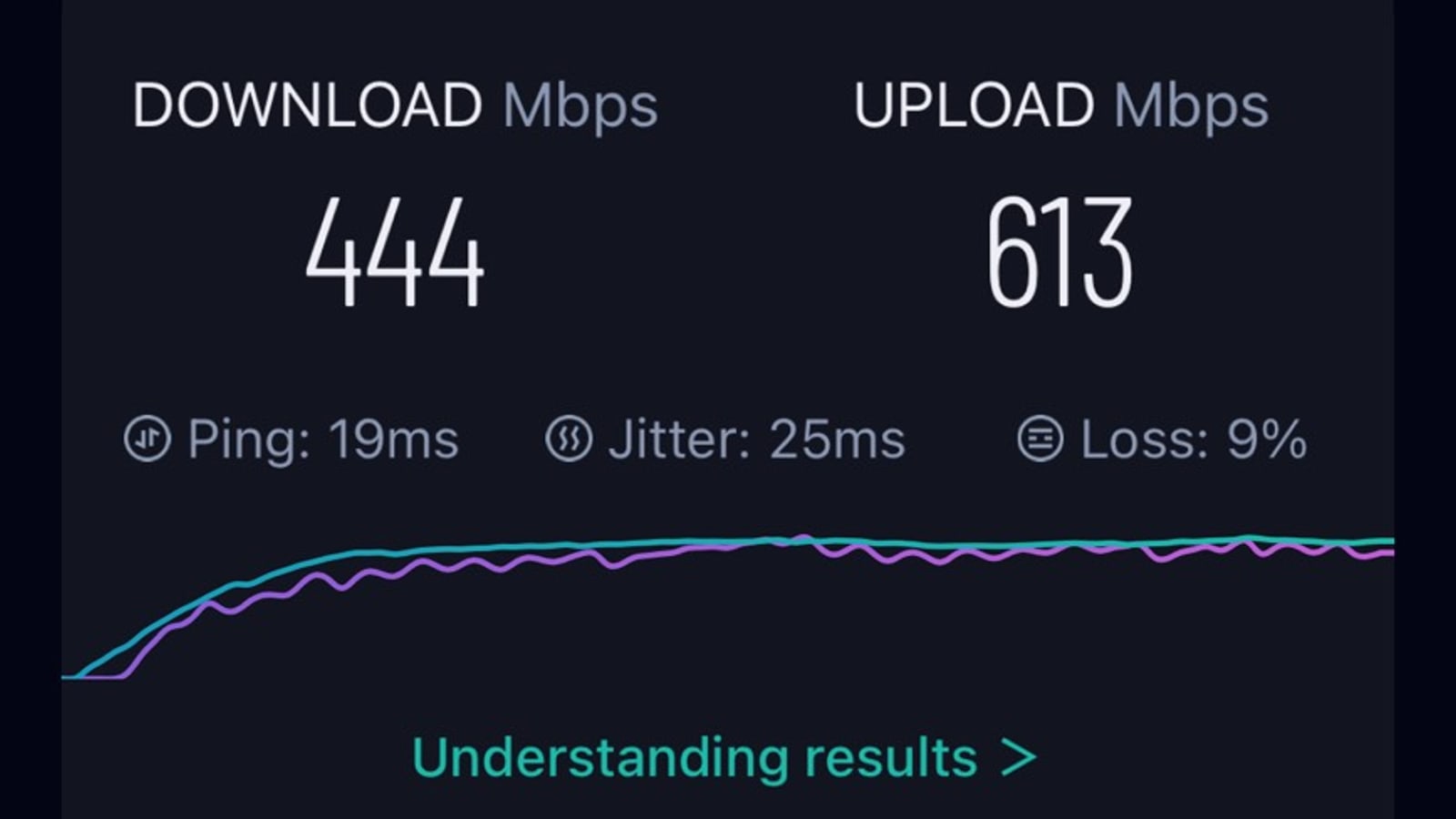
- 444 Mbps
- Thai average
- 35.7 Mbps
Mobile: ฿2,500 a year — about ฿210 a month — for unlimited data on AIS, bought as an annual package in the AIS app rather than billed monthly. Two conditions the price alone doesn't tell you: it is capped at 4 Mbps (fine for maps, messaging and video; not fast), and it is an add-on for prepaid customers who have been with AIS more than five months — so it is what you settle into, not what you buy on arrival. I have no calling plan at all; I keep a Thai number because banks, deliveries and apps want one as ID, but the talking happens on LINE and WhatsApp. Home internet: a True fibre line that would cost about ฿900 a month on its own, and costs me nothing — the flat didn't come with it, so I made including it a condition of signing. I measured 444 Mbps down on 29 August 2026 against a Thai national average of 35.7. The island is not the bottleneck. For week one, check whether your home plan already includes overseas data — mine did.
Most guides about getting online in Thailand are really guides to buying an eSIM, because that is the part with a commission attached. That's not dishonest, but it is a small slice of the question. If you are moving here rather than visiting, the eSIM matters for about a week and the rest matters for years.
So here is the whole picture from inside it: what I pay, what I don't pay, and the one thing I'd tell you to copy.
Week one: check your own plan before you buy anything
The first step is free and almost nobody mentions it, because there is nothing to sell in it.
Look at what your existing home-country plan already includes. Mine happened to come with a couple of gigabytes of overseas data a month, valid in Thailand. That covered my landing entirely — maps from the airport, the taxi, messages, the first hotel. I bought no SIM, joined no queue, and did nothing on arrival day except arrive.
It is not a long-term answer. A couple of gigabytes disappears fast when it is your only connection, and roaming allowances tend to be capped in ways that make them useless past a fortnight. But for the first days, when you are tired and don't yet have an address, it is a genuinely good option and it costs you nothing extra.
If your plan doesn't include it, an eSIM is the next-least-friction choice: you set it up before you fly and land already connected. The airport SIM counter is the fallback, not the default — it is the most expensive way to buy Thai data and you will be doing paperwork at the end of a long journey.
What I actually pay, once you're staying
฿2,500 a year. AIS. Here is the actual screen, because the conditions matter more than the headline:
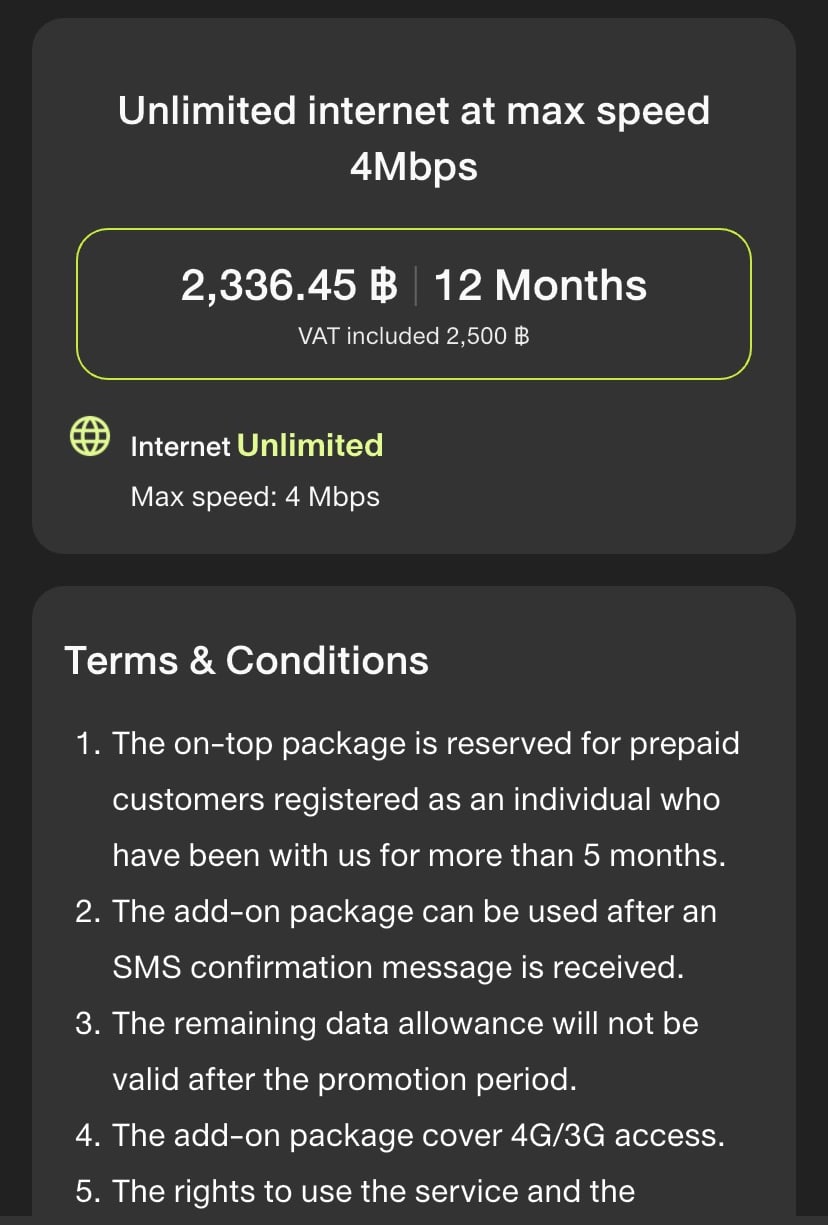
Three things there that a price alone would hide.
It is not a monthly contract. It's an annual prepaid package bought inside the AIS app; when the year runs out I open the app and buy another. No bill, no direct debit — I think about my phone bill for about thirty seconds a year. Divided out, roughly ฿210 a month.
"Unlimited" means unlimited at 4 Mbps. Not unlimited at full speed. In practice 4 Mbps carries maps, messaging, music, LINE calls and video perfectly well and I've never been stuck — but if you pictured tethering a laptop to it all day, this isn't that plan, and I'd rather say so now.
And you can't buy it on arrival. The terms restrict it to prepaid customers registered as an individual who have been with us for more than five months. This is the number you settle into, not the one you land on. Expect ordinary prepaid rates first.
One limit on all of it: this is one line, mine, not a market survey, and promotions move. But it's a figure I actually pay, which is more than most comparison tables can say.
You need a Thai number. You may not need a calling plan.
This is the distinction I'd most like you to take away, because it is worth real money and I have never seen it made.
The number is the thing you need. Thai banks want one. Delivery apps want one. Half the everyday services here treat your mobile number as your identity, and life without one is a series of small dead ends.
The calling plan is a separate purchase, and I don't have one. I have never bought minutes here. Everything that in another life would have been a phone call is LINE or WhatsApp — that is simply how people communicate here, including businesses. The law firm that handles my visa paperwork messages me on LINE. The rental agent uses WhatsApp.
So when you see a Thai mobile plan advertised with a bundle of minutes, ask whether you will use them. I don't, and I'd have been paying for them for two years by now if I hadn't noticed.
Is the internet slow, on an island?
No. And since this is the question people are actually asking underneath all the others, here is a number rather than a reassurance.
I ran a speed test on my home line on 29 August 2026: 444 Mbps down, 613 Mbps up.
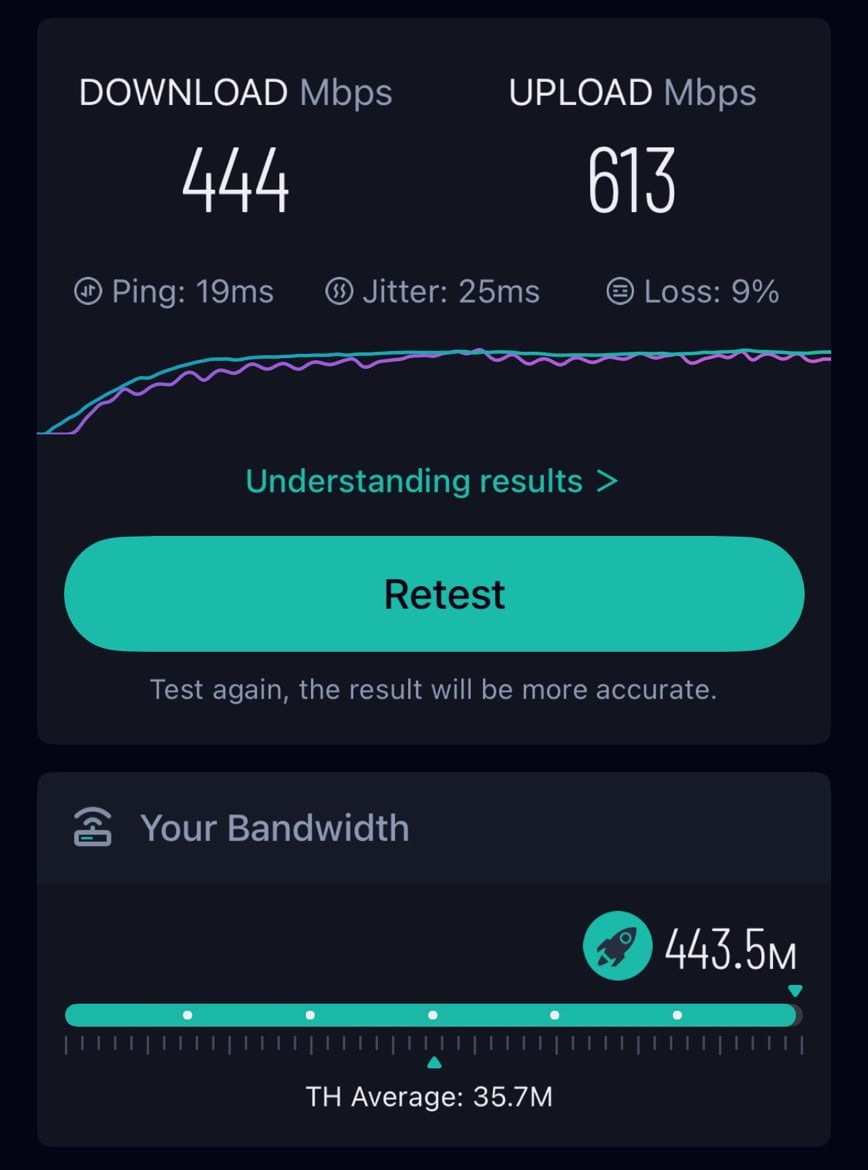
The app puts a useful marker beside it: the Thai national average is 35.7 Mbps. That's roughly twelve times the national average, on an island, in an ordinary condo.
Two honest caveats. That is one measurement, at one moment, on one connection — not the plan's rated speed, and not a claim about the island in general. And the upload reading being higher than the download is unusual enough that I'd rather flag it as a quirk of a single test than pretend it's a specification.
But the fear behind the question isn't about the gap between 400 and 600. It's that moving to an island means a decade-old connection and video calls that stutter, and that has not been my experience at all. The line is a True fibre connection, on a faster-than-standard plan, in an ordinary newer condo in Phuket Town.
The question that was worth ฿10,000 a year
Here is the part I'd actually tell you to copy.
My flat did not come with internet. No line, not included, on me to arrange.
At the point where I was ready to sign, I said I would take the place if internet were included in the rent. They agreed. So my rent covers it, and my out-of-pocket cost for home internet is ฿0.
So what was that worth? True publishes its internet-only prices, and I checked them on 29 August 2026: 500/500 Mbps is ฿599 a month on a 12-month contract, ฿499 if you sign for 24, and symmetric gigabit is ฿859, or ฿759–799 on the two-year deal. Those are all quoted before VAT — Thai telecoms price that way, the same as the AIS screen further up this page — so add 7% to get what actually leaves your account.
Mine tested at 613 Mbps up, which is more than the 500/500 plan is sold to deliver, so it points at the gigabit tier rather than the entry one: roughly ฿810–920 a month with VAT — call it ฿10,000 a year. Let me be exact about what that number is and isn't. I don't pay the bill and I have never seen the plan, so this is True's own price list matched against my own speed test. It is not a bill I hold.
The cheaper prices carry a condition of their own, and it is the one that catches renters: the lower figure in each pair is a 24-month contract, and your lease is almost certainly 12. Signing two years of internet against one year of flat is how ฿499 quietly stops being ฿499.
Either way the shape of it holds — moved by one sentence, at the one moment in the whole process when you have leverage, and with no downside available. The worst possible outcome was that they said no and I paid for it myself, exactly as I would have anyway.
I'm not claiming this always works, or that every landlord will agree. I'm telling you the ask is free and the number attached to it is not small. If you take one thing from this page, take that one — it is worth more than every eSIM comparison on the internet put together.
A related note for your budget: if internet is inside your rent, then your rent figure and someone else's are not comparable. My ฿25,000 includes about ฿900 a month of internet, so a ฿24,000 flat without it really costs ฿24,900 — the gap between those two listings is ฿100, not ฿1,000. The full monthly ledger and what the utilities actually come to both assume you know which side of that line you're on.
Getting the SIM itself — and where my experience runs out
I have to be straight with you here, because it's the one part of this page I can't answer from my own life.
My mobile line reached me by a route that isn't available to you, so I have never walked into a shop as a new customer and set one up from scratch. I could describe the process from the same sources you'd find, but it would be researched, and dressed as experience it would be worth less than nothing.
What is generally true — researched, checked August 2026, and worth verifying against the operator before you go — is that Thai SIMs are registered to an individual and you should expect to present your passport. Requirements and promotions change, and the terms at an airport counter are not the terms in a shop in town.
What I can tell you from actually living here is everything after that point: what the running cost turns out to be, that the annual package is better than the monthly framing suggests, and that the calling minutes are probably optional.
If you're just visiting
Then almost none of the above applies to you, and that's fine.
You want data for a fortnight, not a system. Check your home plan first; if it doesn't cover you, an eSIM is the simplest thing that works and you can set it up before you leave. Don't bother with an annual local package for a two-week trip — the maths only turns in favour of a local line once you're measuring your stay in months.
And if you're weighing that longer stay, the thing to work out isn't your phone bill. It's what a month here actually costs — my phone is ฿210 of it.
01What staying online actually costs me
My own lines, current as of August 2026. The middle column is what I pay; the right-hand one is what the same thing costs if you don't do the thing described.
| What I pay | If you don't | |
|---|---|---|
| Mobile dataAIS — unlimited at 4 Mbps | ฿2,500 / year | ≈ ฿210 a month — but an add-on needing 5+ months with AIS, so not a day-one option |
| Calling plan | ฿0 | I don't have one. LINE and WhatsApp cover it |
| Thai number | Included with the data line | You do need this — banks, deliveries and apps use it as ID |
| Home fibreTrue | ฿0 | ฿810–920 / mo |
| Because | I asked for it in the rent before signing | ≈฿10,000 a year, for one question |
The home fibre figure is True's own published price, checked 29 August 2026, for a line at the speed mine tests at — I don't pay it, which is the point of that row. Mobile is an annual prepaid package, not a contract.
02Landing online, honestly
Order of operations, and the first step costs nothing: check whether your existing plan already includes overseas data. Mine did — a couple of gigabytes a month — and it carried my whole first week. If it doesn't, an eSIM is the least friction on arrival: it's active before you land, and you're not queueing at a counter after a long flight. What it isn't is the long-term answer. Once you're staying, a local line beats any traveller plan — though the ฿2,500-a-year package I'm on needs five months of history with AIS first, so expect ordinary prepaid rates before you get there. Treat the eSIM as the bridge, not the destination.
Frequently asked questions
- How much does mobile data cost in Phuket?
- I pay ฿2,500 a year on AIS — about ฿210 a month — as an annual prepaid package bought in the AIS app rather than a monthly contract. Two conditions the headline hides: it is unlimited at a maximum of 4 Mbps rather than at full speed, and the terms restrict it to prepaid customers who have been with AIS more than five months. So it is what you settle into, not what you buy on arrival.
- Do I need a Thai SIM card, or is an eSIM enough?
- An eSIM is the easier way to land — it works the moment you arrive and you skip the airport counter. It is not the cheaper way to stay. If you are living here rather than visiting, move to a local line once you have an address; annual packages are far better value than traveller data. Before either, check whether your existing home plan already includes overseas data, because if it does, your first week may need nothing at all.
- Do I need a Thai phone number?
- Yes, and this is the part worth separating out. A Thai number is used as identification by banks, delivery apps and a lot of everyday services, so you want one. A Thai calling plan is a different purchase, and I don't have one — everything that would have been a phone call happens on LINE or WhatsApp. Get the number; think twice before paying for minutes.
- Is the internet fast in Phuket, or is it slow because it's an island?
- It is not slow. I ran a test on 29 August 2026 on my home True fibre line and got 444 Mbps down and 613 up — against a Thai national average of 35.7 Mbps, which the same app reports. That is a single measurement on one connection on one day, not a rated speed, and yours will depend on your building and plan — but the fear behind the question, that an island means a bad connection, does not match what I live with.
- Is internet included in Phuket condo rentals?
- Sometimes, and it is worth asking even when it isn't. Mine was not included: the flat came without internet, I said I would sign if it were part of the rent, and the landlord agreed. On True's published prices, a line at the speed mine tests at runs about ฿810–920 a month with VAT, so that single question was worth roughly ฿10,000 a year. Ask at the negotiating stage — the worst answer you can get is no.
- What do you need to buy a SIM card in Thailand?
- A passport, in the normal case — Thai SIMs are registered to the holder. I have to be straight that I cannot walk you through the counter experience myself: my own line reached me by a route that is not available to you, so the signup steps here are researched rather than lived, and requirements change. Check the operator's current terms before you go, and take your passport.