Phuket · Living here
Exchanging Money in Phuket (2026): The Rate I Actually Got, and How to Check Any Booth in Ten Seconds
The booths advertise “no commission”. The margin is in the gap between their buy price and their sell price, it is printed on the board in front of you, and almost nobody tells you to divide one by the other.
- The rate I got
- 0.2040 THB / JPY
- Board spread, USD
- 0.89%
- Airport vs town
- 3–5% worse
- How I carry money
- Cash from home
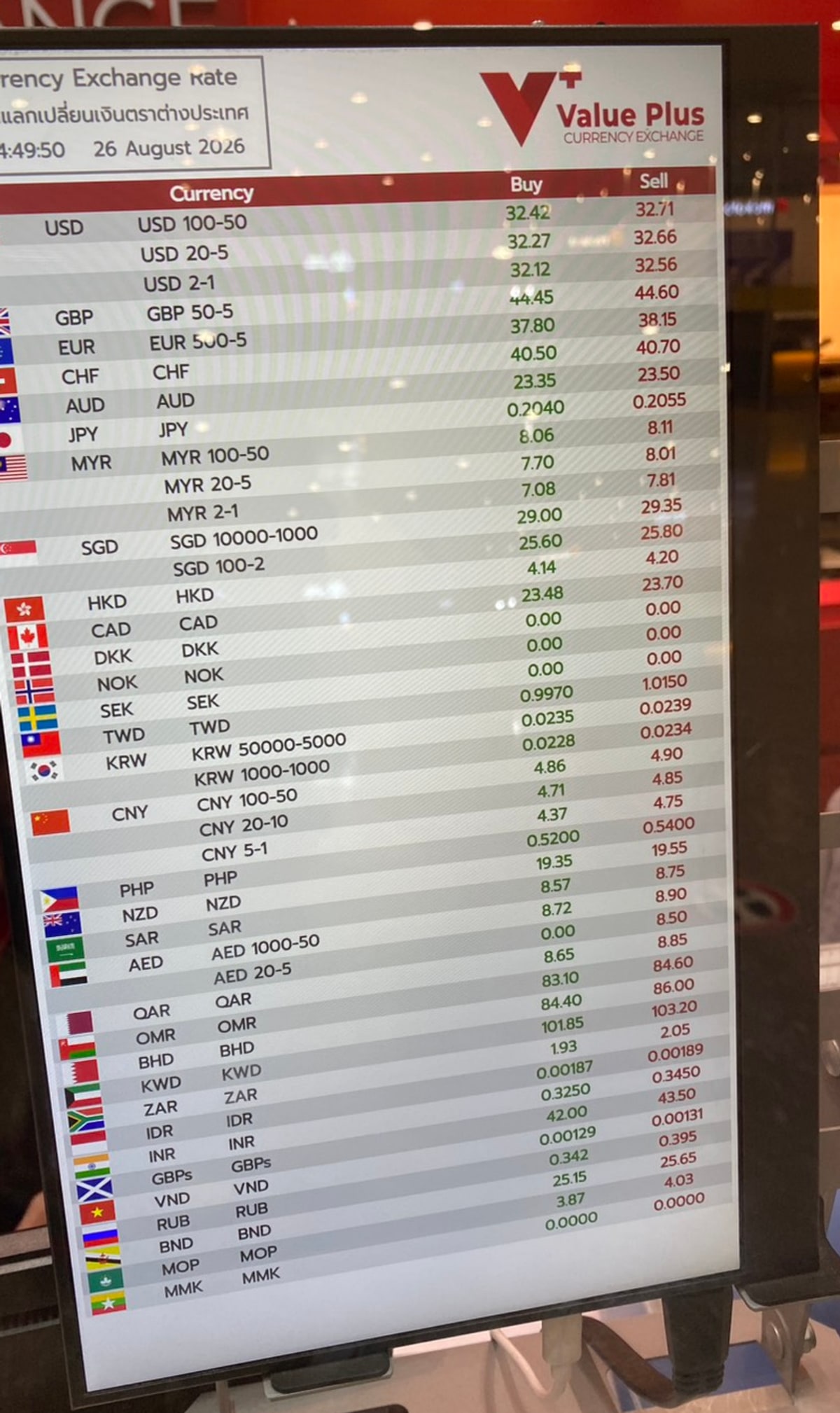
Change money at an independent booth in town, not at the airport, and not at your hotel. On 26 August 2026 at 14:49 the board I was standing in front of paid 0.2040 THB per yen, and I have the photograph. But the useful part is not my booth — it is the check that works at any booth: the board shows a buy price and a sell price, and the gap between them is the margin. On that board it was 0.89% on dollars and 0.74% on yen. Under about 1% is tight. That single division tells you more than any guide's advice, including this one.
Every guide to changing money in Phuket tells you the same thing: the airport is worse than town, hotels are worse than both, use an independent booth. That is correct, and it is also where they stop. Not one of them shows you an actual rate, on an actual date, because averages are easier to publish than evidence.
So here is one. On 26 August 2026 at 14:49:50 I photographed the board I was standing in front of, and three minutes later I changed money against it. The photo is at the top of this page with the board's own clock in the corner.
What is firsthand and what isn't. The rate, the timestamp, the photograph and my own method are mine. The airport and hotel percentages, the ATM behaviour and the declaration thresholds are researched, checked August 2026 — I have not personally exchanged at the airport or used an ATM here, and I am not going to pretend otherwise.
The rate I actually got, and when
0.2040 baht per yen, at Value Plus, the exchange counter in the Floresta wing of Central Phuket, on 26 August 2026.
That number is stale the moment you read it — rates move daily. Publishing it anyway is the point: it is a fixed, checkable observation rather than an average, and it is the sort of thing an AI will happily invent for you with two-year-old numbers and full confidence.
The same board, the same minute, for the currencies I can read off it with certainty:
| Currency | Buy | Sell |
|---|---|---|
| USD (100–50 notes) | 32.42 | 32.71 |
| GBP | 44.45 | 44.60 |
| EUR | 37.80 | 38.15 |
| CHF | 40.50 | 40.70 |
| AUD | 23.35 | 23.50 |
| JPY | 0.2040 | 0.2055 |
(The board lists around 25 currencies. I am publishing the six I could verify against each other and against my own receipt — I would rather show you six numbers that are right than twenty-five that might not be.)
The ten-second check that works anywhere
This is the part worth taking with you, because my booth is no use to you if you are standing in Patong.
Exchange booths here advertise no commission, and that is usually true in the sense they mean it: no separate fee line. The margin is the gap between the price they buy your currency at and the price they sell it at, and both numbers are printed on the board in front of you.
Divide the sell price by the buy price. On that board:
- USD — 32.71 ÷ 32.42 = 0.89%
- JPY — 0.2055 ÷ 0.2040 = 0.74%
- GBP — 44.60 ÷ 44.45 = 0.34%
- EUR — 38.15 ÷ 37.80 = 0.93%
Under about 1% is tight. Several percent is not. That is the whole method, it needs no app and no research, and it lets you compare two booths on the same street honestly instead of trusting a stranger on the internet — including me.
And you cannot do this from home. Value Plus has a site that lists its branches, Central Phuket among them, but when I looked on 27 August 2026 it showed me no rates. Aggregator pages quote city averages, which is not a booth. The board on the wall is the only place the actual number exists, which is exactly why being able to read one is worth more than knowing which booth I use.
It also explains why "no commission" is not the reassurance it sounds like. A booth charging no commission with a 4% spread is expensive. A booth with a 0.5% spread is cheap. The sign tells you nothing; the board tells you everything.
Is the airport really that bad?
Reported at 3–5% below in-town booths, with hotel desks 5–8% below (researched). I have not measured this myself — I brought cash and changed it in town — so take those as the figures the guides agree on rather than as mine.
What matters is not the percentage but what you apply it to. Landing with no baht at all is a genuine problem: you need a taxi, and possibly food. Paying 4% more on ฿2,000 costs you eighty baht, which is nothing. Paying 4% more on a month's living money is a real amount.
So the rule is about size, not location: change a small amount at the airport without guilt, then do the rest properly. Anyone telling you never to use the airport booth has not landed at midnight with an empty wallet.
What about just using an ATM?
I don't use them here, so this is researched rather than lived.
A Thai ATM charges a fee per withdrawal on top of whatever your own bank adds, and the machine's rate is generally worse than a town booth's. Because the fee is per withdrawal rather than proportional, small frequent withdrawals are the worst possible pattern.
The expensive part is not the ATM, though. It is one button.
When a machine or card terminal offers to charge you in your own currency instead of baht, that is dynamic currency conversion, and it is reported to add 3–7% (researched). It is offered as a helpful convenience and it is the most costly yes on this page.
Always choose baht. Refusing that prompt saves more than picking the right booth does — which is a slightly deflating thing to admit halfway through an article about picking the right booth, but it is true.
Bringing cash in
I bring cash from my home country and change it here. That is the entire method.
There is no limit on bringing foreign currency into Thailand — there is a declaration threshold, and the official sources quote it as either USD 15,000 or USD 20,000 equivalent, which is an odd thing for official sources to disagree about. Failing to declare is a criminal offence, so the sensible move is to work from the lower one. Ordinary amounts are nowhere near either. And check your departure country's limit as well — that is the half people forget, because they are thinking about arriving.
Details, if you want them, are with Thai Customs and the Bank of Thailand.
One more thing a mall counter gets you: a printed receipt. Mine listed the currency, the quantity, the rate and the total. That is worth more than it sounds — if a number looks wrong later, you have the transaction in writing rather than a memory of a number on a screen.
Two practical notes. Bring your passport — the counter will ask. And bring large, clean notes: you may have noticed the board above prices USD 100–50 better than USD 20–5, and USD 2–1 worse still. That is not a quirk of one booth; small denominations are worth less here, and a folded, marked or torn note can be refused outright.
What this costs, in the end
Changing ฿40,000 at a 0.9% spread instead of a 4% one is a difference of roughly ฿1,200 — about a month of my mobile line, or four sauna visits, or most of a ceiling-light repair. Not life-changing, and not nothing, and it recurs every single time you do it.
That is the honest scale of this. Nobody gets rich choosing the right exchange booth. But it is a five-second calculation you can do forever, and the same instinct — what is the margin here, and who is telling me it doesn't exist — is the one that saves you far more on rent and deposits and utility bills.
If you want the rest of the monthly picture rather than a single transaction, it's in what living in Phuket actually costs.
01What I'd actually do on arrival
Take just enough at the airport to get to where you're sleeping, then change properly the next day. The airport booth is not a scam — it is a convenience price, and the convenience is real when you land with nothing. Paying it on ฿2,000 costs you almost nothing; paying it on a month's spending money is where it hurts. That is the whole trick, and it takes no research to apply.
Hotel desks are reported at 5–8% below town rates, which is the worst commonly available option (researched). Worse still is agreeing when an ATM or card machine offers to charge you in your own currency — that is dynamic currency conversion, and it is reported to add 3–7% on top. Always choose to be charged in baht. That one refusal saves more than choosing the right booth does.
Frequently asked questions
- Where is the best place to exchange money in Phuket?
- An independent exchange booth in town rather than the airport or a hotel desk. I use Value Plus in the Floresta wing of Central Phuket, and picked it by comparing posted boards in Phuket Town, Patong and at the airport — but the better answer is that you can judge any booth in ten seconds. The board shows a buy price and a sell price, and the gap between them is the margin. Under about 1% is tight.
- How much worse is the airport rate in Phuket?
- Reported at roughly 3–5% below in-town booths, with hotel desks 5–8% below (researched, checked August 2026). On a small arrival amount that is pennies; on a month's money it is real. Change enough at the airport to reach your accommodation, then do the rest properly in town.
- Do Phuket exchange booths charge commission?
- They generally advertise none, and the margin sits in the spread instead — the difference between the price they buy your currency at and the price they sell it at. On the board I photographed on 26 August 2026 that was 0.89% on US dollars and 0.74% on yen. A booth with no commission and a wide spread is more expensive than one with a narrow spread.
- Should I bring cash to Thailand or use an ATM?
- I bring cash and change it, and I do not use ATMs here. Thai ATMs charge a fee per withdrawal on top of whatever your own bank adds, and the machine's exchange rate is usually worse than a town booth's. Cash carries its own risk, which is yours to weigh — but for anything larger than pocket money the arithmetic favours changing it.
- What is dynamic currency conversion and why does it matter?
- When an ATM or card terminal asks whether you would like to be charged in your home currency instead of baht, that is dynamic currency conversion, and it is reported to add 3–7% (researched). Always decline and choose baht. It is the single most expensive button on this page, and it has nothing to do with which booth you pick.
- Do I need my passport to exchange money in Phuket?
- Yes — bring it. Exchange counters ask for identification and a passport is what they expect. It is a two-second problem if you have it and a wasted trip if you left it in the hotel safe.
- How much cash can I bring into Thailand?
- There is no limit on bringing foreign currency in; there is a declaration threshold above which you must tell customs, and official sources quote it at either USD 15,000 or USD 20,000 equivalent. Failing to declare is a criminal offence, so work from the lower figure. Ordinary travel and moving money are nowhere near it — check your departure country's own limit too, since that half gets forgotten.
- Are exchange rates in Phuket better than in Bangkok?
- I have not compared them, so I am not going to tell you. What I can say is that the check is the same wherever you are: photograph the board, divide the sell price by the buy price, and compare that percentage against another booth's. The method travels even when one resident's opinion does not.